

At a glance
From 6 April 2027, most unused pension funds and pension death benefits will be included in a deceased person's estate for UK Inheritance Tax (IHT). This is a major shift because pensions have often sat outside the estate and have therefore been used not only to fund retirement but also as an efficient way to pass wealth to the next generation.
The change does not mean everyone should empty their pension before April 2027. It does mean that anyone with a meaningful pension pot, especially alongside a valuable home, investments or business assets, should revisit the order in which they spend, gift and retain assets.
| Question | Position from 6 April 2027 |
|---|---|
| Are unused pension funds within the estate for IHT? | Generally yes. |
| Are pension death benefits generally within the estate? | Generally yes, subject to specific exclusions. |
| Are registered pension death-in-service benefits caught? | No. They are specifically excluded. |
| Who reports and pays the IHT? | Personal representatives are responsible, with new pension scheme information and payment procedures. |
| Can beneficiaries still face Income Tax on inherited pension benefits? | Yes in some cases, particularly where the member dies aged 75 or over. |
| Does the £2 million residence nil-rate band taper matter? | Yes. Adding a pension to the estate can reduce or eliminate the residence nil-rate band. |
What is changing on 6 April 2027?
The reform applies to deaths on or after 6 April 2027. Under the legislation enacted in Finance Act 2026, most unused pension funds and pension death benefits will become part of the value of the deceased's estate for IHT purposes, even where scheme trustees or administrators retain discretion over who receives the benefit.
The policy reverses one of the most attractive estate-planning features of pensions. Under the current regime, many discretionary pension death benefits fall outside the estate for IHT, which has encouraged some people to preserve pensions while spending ISAs, cash and other investments first.
Which pension benefits are caught?
The starting point is broad: most unused defined contribution pension funds and most pension death benefits will be brought into the estate. The precise treatment will depend on the type of pension and benefit, so scheme-specific advice will become increasingly important where large sums are involved.
There are important exclusions. In particular, death-in-service benefits payable from registered pension schemes are excluded, as are certain dependant's scheme pensions from defined benefit arrangements and collective money purchase arrangements.
Why this matters even if your estate is already taxable
The obvious effect is that a larger estate can create a larger IHT bill, normally at 40% on the taxable amount after available exemptions, reliefs and nil-rate bands. The less obvious effect is that adding the pension can change which allowances are available in the first place.
The residence nil-rate band is currently £175,000 per person where the relevant conditions are met, and unused allowance can potentially transfer between spouses or civil partners. However, it is tapered by £1 for every £2 by which the estate exceeds £2 million, so a pension brought into the estate can indirectly increase IHT by causing this allowance to disappear.
Could the same pension suffer both IHT and Income Tax?
Potentially, yes, and this is one of the most important planning points. The 2027 reform changes the IHT treatment, but it does not simply abolish the existing Income Tax rules that can apply when beneficiaries receive pension death benefits.
Broadly, where a member dies before age 75, qualifying pension death benefits can often be received by beneficiaries without Income Tax, subject to the detailed pension rules. Where the member dies aged 75 or over, taxable pension withdrawals by an individual beneficiary are generally taxed at that beneficiary's marginal rate of Income Tax.
Should you draw down your pension before April 2027?
Not automatically. Taking money out of a pension can reduce the amount exposed to the new pension-IHT rules, but it can also trigger Income Tax and move cash into your ordinary estate, where it remains exposed to IHT unless it is spent, gifted or otherwise planned for effectively.
The right question is therefore not simply whether to withdraw the pension. It is whether your overall retirement and estate plan would be more efficient if you changed the order in which you draw pension, ISA, cash, investment portfolio and other assets.
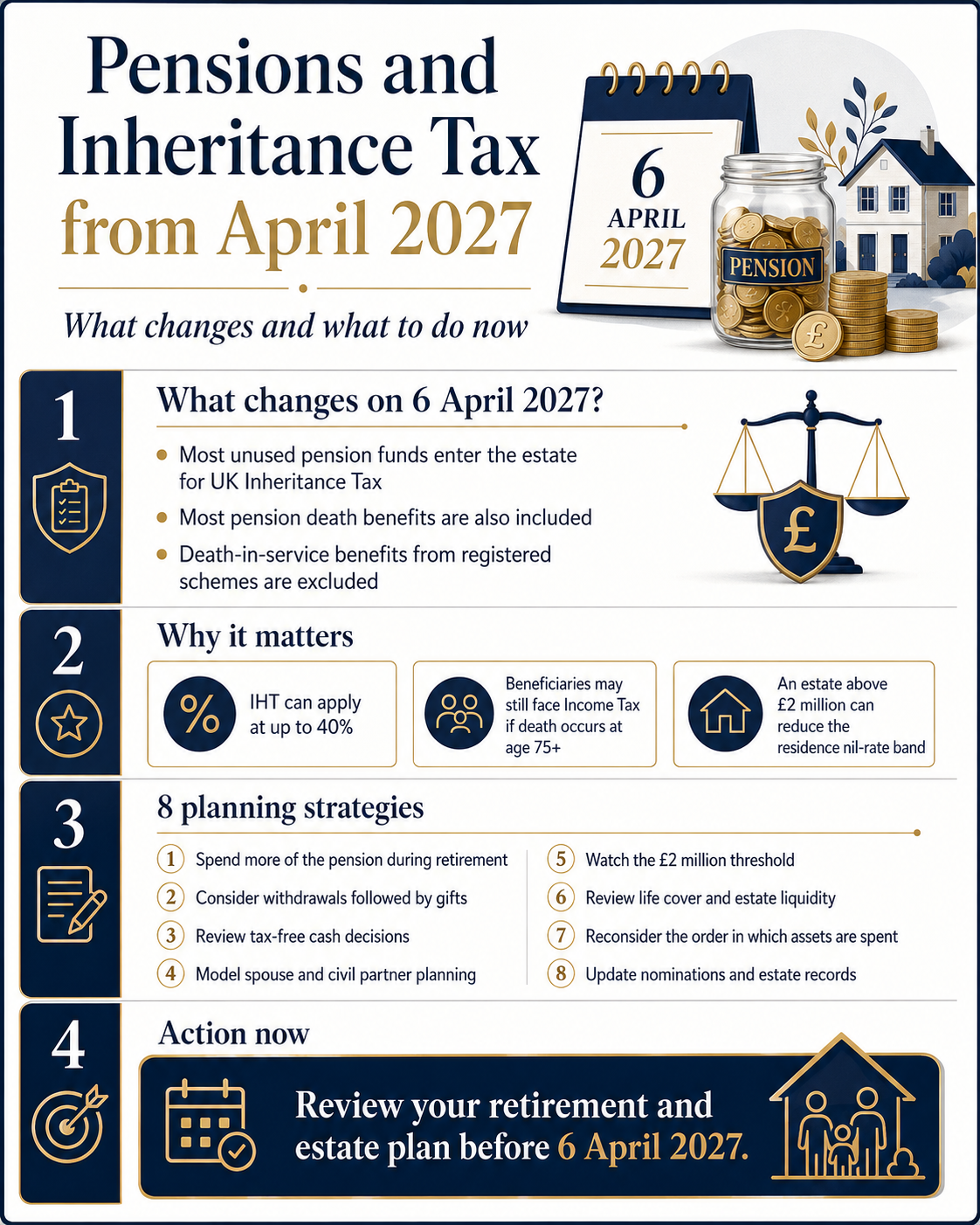
1. Spend more of the pension during retirement
For some clients, the reform strengthens the case for using pension funds for their original purpose: retirement spending. If pension assets are no longer uniquely protected from IHT, preserving them at all costs may make less sense than it did under the old regime.
This can be particularly relevant where someone has been spending taxable investments or ISAs while deliberately leaving a large SIPP untouched for children. The optimal withdrawal sequence may now need to be reversed or at least rebalanced.
2. Consider withdrawals followed by genuine lifetime gifts
A pension withdrawal can create cash that is then gifted, potentially starting the seven-year clock for a potentially exempt transfer to an individual. This can be powerful, but only if the Income Tax cost of the withdrawal and the donor's own cash-flow needs justify the strategy.
Regular gifts out of surplus income may also be relevant where the statutory conditions are met. That exemption is often underused, but it requires evidence of a normal pattern of giving and that the donor retains enough income to maintain their usual standard of living.
3. Revisit tax-free cash decisions
Some people have deliberately avoided taking pension commencement lump sums because retaining money in the pension could historically improve IHT protection. From 2027, that logic weakens, although taking tax-free cash without a plan for what happens next may simply exchange one IHT-exposed asset for another.
The analysis should therefore include what the cash will be used for. Spending, gifting, debt repayment or investment into a structure with different tax characteristics can all produce very different outcomes.
4. Review spouse and civil partner planning
Transfers to a spouse or civil partner are generally exempt from IHT, subject to the detailed rules. This can defer the IHT problem rather than eliminate it, because the surviving spouse may ultimately die with an even larger combined estate.
Couples should therefore model the second death, not just the first. Pension nominations, wills, asset ownership and each person's available nil-rate bands should be reviewed together rather than in isolation.
5. Pay close attention to the £2 million threshold
For estates near £2 million, the pension reform can create a disproportionate effect because the residence nil-rate band begins to taper above that level. A relatively modest planning adjustment before death may therefore preserve an allowance as well as reduce the estate itself.
This is an area where modelling matters more than slogans. Two families with the same £500,000 pension can face very different consequences depending on the value of their home, marital history, previous gifts and transferable allowances.
6. Review life assurance and liquidity
Where an IHT liability is expected rather than avoidable, life assurance written under an appropriate trust can sometimes provide liquidity for heirs without increasing the taxable estate. This does not reduce the underlying tax bill, but it can prevent beneficiaries from being forced to sell investments, property or business assets at the wrong time.
Premium affordability and underwriting are crucial, so this is generally more useful when considered early. It should also be integrated with the estate plan rather than sold as a stand-alone solution.
7. Reconsider the role of ISAs and taxable investments
The historic rule of thumb was often to spend non-pension assets first and preserve the pension for heirs. Once pensions lose much of their IHT advantage, the comparative benefits of ISAs, taxable portfolios and pensions need to be recalculated rather than assumed.
Income Tax, Capital Gains Tax, dividend tax, access, investment flexibility and IHT all interact. The best sequence is therefore personal to the investor, but the 2027 change makes an old default strategy much less reliable.
8. Make sure pension nominations and estate records are current
Expression-of-wish forms and beneficiary nominations still matter even though the IHT treatment is changing. Executors will also need enough information to identify pension schemes, obtain values and deal with the new information-sharing process efficiently.
Good record-keeping will become more important because the personal representatives will be responsible for reporting and paying the IHT attributable to pension assets. HMRC's August 2026 technical note sets out a framework for information exchange between personal representatives and pension scheme administrators.
How will the IHT actually be paid?
HMRC's latest technical material recognises a practical problem: executors may owe IHT partly because of pension assets that they do not themselves control. The new process therefore allows personal representatives, where they reasonably expect IHT to be due, to direct a pension scheme administrator to withhold part of taxable pension benefits while the liability is finalised.
Under the published framework, up to 50% of certain taxable benefits can be withheld for up to 15 months from the date of death, and the scheme can in specified circumstances make a direct payment towards the IHT. These procedures are intended to reduce the risk that executors have to fund pension-related IHT personally before beneficiaries receive the pension money.
What if you live outside the UK?
Leaving the UK does not automatically remove UK IHT exposure. Since 6 April 2025, the old domicile and deemed-domicile framework has been replaced for these purposes by a long-term UK residence regime, which can bring overseas assets within UK IHT and can continue to have consequences for a period after an individual leaves the UK.
This is particularly important for internationally mobile people who have accumulated large UK pension rights. The pension rules, the new residence-based IHT framework and the tax law of the country where the individual or beneficiaries live all need to be considered together.
For example, what if you live in France? A UK pension owned by someone living in France can now sit at the intersection of UK pension taxation, UK IHT rules and French succession or tax rules. Treaty analysis may also be required, and the answer can differ depending on residence history, nationality, the nature of the pension and who ultimately receives the benefits.
This is exactly the type of case where a UK-only estate plan can be misleading. A strategy that reduces UK IHT can create a French tax or succession consequence, so cross-border modelling should be done before implementing withdrawals, gifts or beneficiary changes.
Common mistakes
Emptying the pension purely to avoid IHT
A large withdrawal can trigger substantial Income Tax and may simply leave cash sitting inside the taxable estate. A withdrawal is useful only if the next step, such as spending or gifting, improves the overall position.
Ignoring the residence nil-rate band taper
The pension can push an estate above £2 million and reduce the residence nil-rate band as well as adding taxable value. This can make the effective cost of the reform larger than a simple 40% calculation suggests.
Assuming pension nominations no longer matter
The IHT treatment changes, but beneficiary nominations remain important for how pension death benefits are administered and distributed. They should still be reviewed whenever family circumstances or the estate plan changes.
Waiting until April 2027 to review the plan
Gift planning, insurance, investment restructuring and pension withdrawal strategies can take time and may have multi-year tax consequences. The useful planning window is before the rules take effect, not after the first estate is caught by them.
What should you do before 6 April 2027?
Start by calculating your estate twice: once under today's pension treatment and once assuming your unused pension is fully brought into the estate. Then model the effect on the ordinary nil-rate band, residence nil-rate band, spouse exemptions, previous gifts and the likely Income Tax position of pension beneficiaries.
Next, compare several realistic strategies rather than jumping to a single answer. These should normally include doing nothing, increasing pension withdrawals, making lifetime gifts, changing the order in which assets are spent, reviewing insurance and testing the consequences of surviving for different periods after a gift.
The bottom line
The 2027 pension-IHT reform removes one of the strongest reasons for treating pensions as the asset that should always be preserved until last. For many families, pensions will remain excellent retirement and tax-planning vehicles, but their role in estate planning is changing materially.
The most valuable action is not to withdraw everything before the deadline. It is to re-run the entire retirement and estate plan under the new rules, especially where the combined estate is near or above £2 million, the pension is large, beneficiaries are higher-rate taxpayers or the family has cross-border connections.
Official sources and further reading
HMRC published its second technical note on 27 August 2026, giving further detail on information sharing, withholding, direct pension payments and the Income Tax interaction. The core reform and exclusions are also explained in the government's policy paper on unused pension funds and death benefits.
For readers who have left the UK, HMRC's guidance on the long-term UK residence rules explains how the IHT framework changed from 6 April 2025. These rules should be read alongside the pension reform rather than treated as a separate issue.