

The Renters' Right Act 2025 – What UK Landlords Need to Know
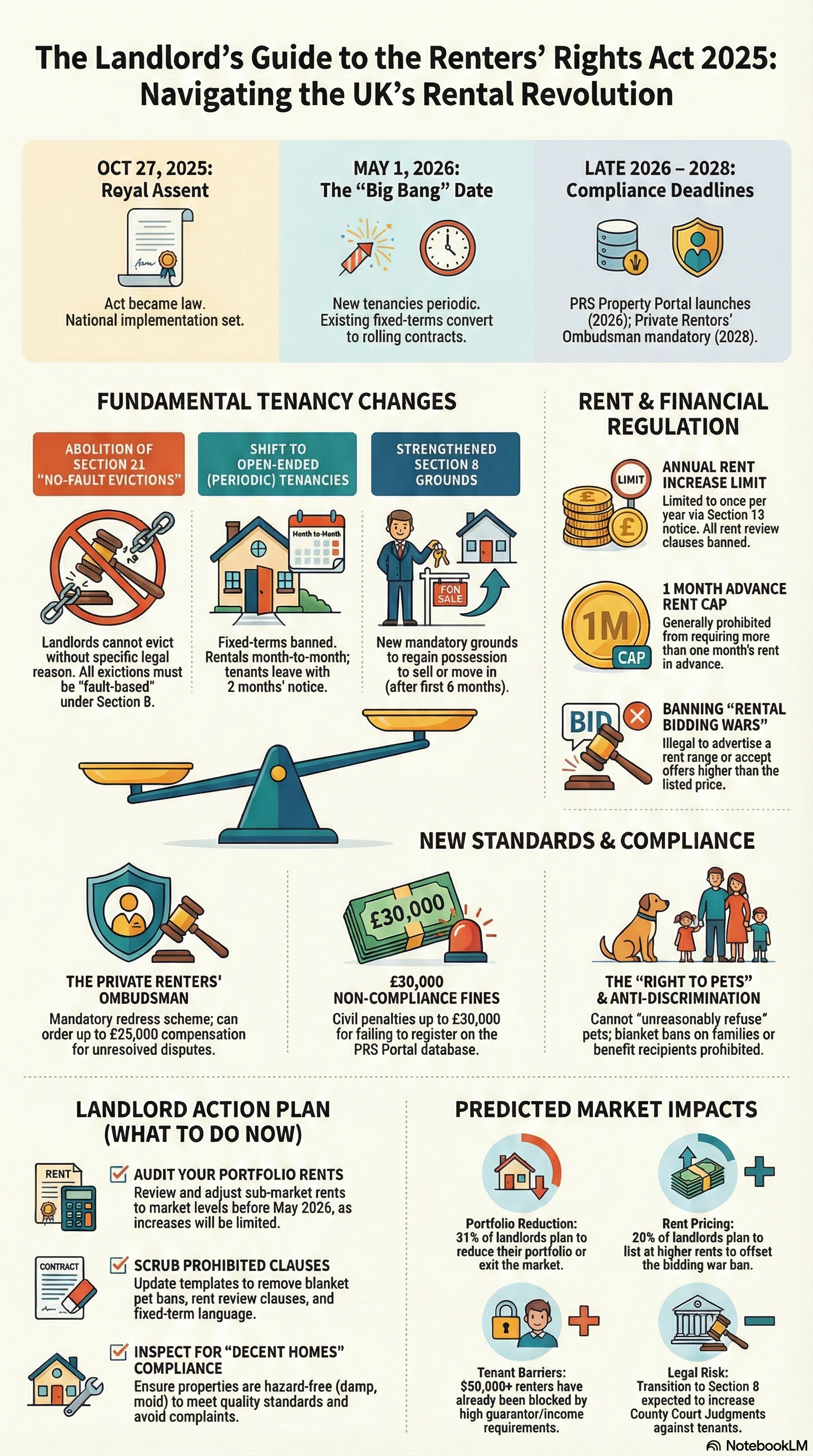
Major changes are coming to the private rental sector in England. The Renters (Reform) Bill originated by the previous gourverment was reintroduced by the current Labour government, and it has now completed its parliamentary process. It received Royal Assent on 27 October 2025. so it's now finalized. It has become law as the Renters' Rights Act 2025 (RRA 2025) and is scheduled to take effect from 1 May 2026. This landmark legislation introduces the biggest shake-up of landlord-tenant rules in a generation, fundamentally altering how landlords rent out property. Below we break down the RRA's main changes in plain English, explain what they mean for landlords in practice, and explore possible unintended consequences. We also highlight what both landlords and tenants are saying about these reforms, drawing on recent policy discussions and social media debates.
Key Changes of the Renters' Right Act 2025
End of ‘No Fault’ Section 21 Evictions
Perhaps the most significant reform is the abolition of Section 21 evictions. Landlords will no longer be able to evict tenants without giving a specific reason. In other words, the familiar “no-fault” eviction notice (two months’ notice to leave with no justification) will be history. This ends the scenario where a tenant could be asked to move out despite having done nothing wrong. Going forward, every eviction will require a valid ground (cause) under Section 8 or other legal provisions – landlords can’t simply serve notice for convenience. This change is intended to give tenants more security in their homes and prevent arbitrary or retaliatory evictions. However, it also means regaining possession will only be possible if you can prove a legitimate reason, as discussed more below.
Changes to Section 8 Eviction Grounds
To balance the loss of Section 21, the RRA strengthens and expands Section 8 grounds for possession. New grounds will allow landlords to evict if they intend to sell the property or move in themselves or close family – though typically only after the first 6 months of a tenancy, to prevent abuse. Existing fault-based grounds are being bolstered as well. For example, if a tenant falls into serious rent arrears or engages in anti-social behaviour, the revised Section 8 process should make it easier and faster to regain possession. The government has signaled that it will make repossessions “easier to repossess properties where tenants are at fault,” through updated mandatory grounds and court reforms. In short, landlords will still be able to evict problem tenants – but they must use the prescribed legal grounds and provide evidence for the tenant’s breach (such as non-payment, property damage, illegal activity, etc.). Also, a new mandatory ground for sale is being introduced, so you can eventually sell your property, just not at short notice without cause. These changes aim to ensure that while bad actors can be evicted, good tenants don’t live under constant threat of losing their home for no reason.
Introduction of Rolling (Open-Ended) Tenancies
The RRA will abolish fixed-term Assured Shorthold Tenancies (ASTs) entirely. Instead, all new tenancies will be periodic from the start, rolling month-to-month (or week-to-week) with no fixed end date. Tenants will have the right to give 2 months’ notice to leave at any time (after their tenancy’s start). This effectively creates open-ended tenancies: renters won’t be locked into six- or twelve-month terms, and they won’t face a cliff edge where their lease might not be renewed. For landlords, this means you cannot insist on a 12-month fixed contract to guarantee occupancy. All tenancy agreements will become “assured periodic tenancies” by law on 1 May 2026, including existing fixed terms which will automatically convert to periodic on that date. Tenants still must pay rent for the notice period and give at least two months’ notice to quit, which actually doubles the current notice most periodic tenants give (previously one month). This change gives tenants more flexibility to move out (e.g. to take a job in another city or if the property is substandard) without being trapped in a fixed term. However, it also introduces challenges: for instance, student landlords worry that students could leave mid-academic year, making it hard to re-let rooms. The government has acknowledged the student housing issue and indicated it may adjust the policy (such as a specific possession ground or exemption for genuine student lets). For most standard rentals, though, the move to rolling tenancies is meant to encourage longer-term landlord-tenant relationships rather than a cycle of fixed-term contracts.
A New Ombudsman for Private Renters
Another major reform is the creation of a Private Renters’ Ombudsman service. All private landlords will be required to join this government-approved redress scheme (a membership-based ombudsman) once it is up and running. The ombudsman will offer tenants a free, impartial forum to resolve disputes and complaints about their landlord without going to court. Importantly, the Ombudsman will have legal powers to issue binding resolutions – it can compel landlords to apologize, provide information, take certain actions to remediate issues, or even pay compensation up to £25,000 to tenants if a complaint is upheld. This means, for example, if a tenant has a serious grievance (like disrepair that wasn’t addressed), they could go to the Ombudsman and you might be ordered to fix the issue and possibly compensate the tenant. The idea is to provide quicker, cheaper dispute resolution than the court system. For landlords, it introduces a new compliance obligation (joining the scheme and adhering to its decisions). Membership will likely involve a modest fee (the RRA pledges the cost will be “proportionate and good value” for landlords). By 2028 it’s expected to be mandatory to be in the ombudsman scheme, with fines up to £30,000 for non-compliance. In practice, this is similar to redress schemes already in place for letting agents – soon, every landlord must be registered with the Ombudsman, giving tenants an accessible route for complaints. Good landlords who maintain standards may never hear from the Ombudsman, but those who ignore their responsibilities could face binding rulings.
A New Property Portal (PRS Landlord Database)
The RRA also introduces a Private Rented Sector (PRS) Portal, essentially a national landlord and property registration database. All landlords will be required to register themselves and their rental properties on this portal, which will be publicly accessible to some degree. The portal will serve multiple purposes: it will help local councils identify and enforce against non-compliant or rogue landlords, provide a one-stop reference for landlords to understand their legal obligations, and give tenants a way to check that a landlord is legitimate and see basic information about a property’s compliance (for example, safety certificates). England is catching up here – Scotland, Wales, and Northern Ireland have had landlord registration schemes for years. The database is set to roll out regionally from late 2026 and become fully mandatory by 2027. If a landlord fails to register and then lets or advertises a property, they can face a hefty fine (penalty) up to £30,000 and even a ban on letting for repeated offenses. In practice, this means an extra administrative step for landlords (likely an online form to input your details and upload documents for each property). It’s wise to keep organized records of things like Gas Safety, EPC, deposit protection, etc., since the portal may require you to report or upload such compliance info. While this might seem burdensome, the goal is to improve transparency and accountability in the rental market. Good landlords who already follow the law should find registration straightforward – it’s the “invisible” landlords operating under the radar that this aims to root out.
Stricter Rules on Rent Increases
The Renters Reform will change how and when landlords can raise the rent on periodic tenancies. Rent increase notices will be limited to one increase per year (12 months) . Landlords must use a Section 13 notice to propose any rent hike for periodic tenancies, giving at least two months’ notice of the increase. Crucially, any rent review clauses in tenancy agreements will be banned – you cannot circumvent the annual limit or the process by writing alternative rent escalation terms into a contract. This means the common practice of including a clause like “rent will increase by X% after 6 months” will no longer have any effect; all increases must follow the statutory process. For many landlords, this won’t change routine practices (most tend to review rent annually or at tenancy renewal anyway). But if you’ve been raising rent more frequently or by large amounts ad-hoc, that will not be allowed. Tenants will also have more power to challenge unfair rent increases. As today, a tenant who feels an increase is above-market can refer the Section 13 notice to the First-tier Tribunal for review. The difference now is every tenancy becomes periodic (so Section 13 is the only route for increases) and the government plans to digitize and simplify the tribunal referral process, likely resulting in more tenants appealing rent hikes. Early signs suggest a significant minority of tenants (in one poll, 22%) might challenge rent rises even if they seem fair, just to test the system. Landlords should be prepared for the possibility of more frequent rent disputes. The bottom line: going forward, you can raise rent at most once a year (if market conditions allow), and you’ll need to formalize it through the proper notice – with the understanding that tenants can push back via a tribunal.
Other Notable Reforms (eg. discrimination and standards)
Beyond the headline items above, the Renters' Rights Act includes several other changes worth noting:
- Permitting Pets: Tenants will gain a right to request a pet in their rental home, and landlords cannot unreasonably refuse. If your tenant asks in writing to get a pet, you must consider it in good faith. You can require the tenant to obtain pet damage insurance (this will be a permitted charge under the Tenant Fees Act) to cover any potential damage. You can still say no if there’s a valid reason (e.g. unsuitable pet for the property or building rules forbid it), but blanket “no pets” policies will effectively be outlawed. Expect more tenants to have pets, and factor in potential wear-and-tear.
- No More “No DSS” or Child Bans: It will become illegal to impose blanket bans on renting to tenants just because they are on benefits or have children. Landlords and agents must consider applicants on a case-by-case basis, rather than automatically rejecting those who rely on Universal Credit/housing benefit or those with families. This change enshrines fairness and combats discrimination. (Of course, you can still perform affordability checks – you just can’t state a policy refusing benefit claimants or families.) Note that many benefit recipients struggle to afford high rents anyway, so the practical impact may be limited in areas where Local Housing Allowance falls short. Nonetheless, any advert or practice of “No DSS” will be against the law.
- Decent Homes Standard: For the first time, private rentals will have to meet the Decent Homes Standard, which is currently enforced in social housing. This is a set of basic quality criteria – for example, properties should be free from serious health/safety hazards, in a reasonable state of repair, and have decent facilities and insulation. Government data indicates around 21% of private rentals would currently fail the standard, so many landlords may need to invest in improvements over the coming years. The Act extends “Awaab’s Law” as well, meaning issues like toxic mold must be addressed promptly to avoid legal consequences. The Decent Homes requirement isn’t kicking in immediately in 2026; it’s part of a later phase (by 2030). But it’s on the horizon, so landlords should start ensuring their properties are safe, well-maintained, and up to standard to avoid penalties down the line.
- Banning Rental Bidding Wars and Advance Rent: In recent years, tenants in high-demand areas have been pressured to outbid each other – offering above the asking rent or many months’ rent upfront – to secure a home. The new law will ban rent bidding. Landlords and letting agents cannot advertise a property for a rent range or invite offers above the listed price. You also cannot accept a higher rent than what you initially asked for* (no more gazumping hopeful tenants). This aims to stop “auction” scenarios that drive rents even higher. Additionally, landlords will be prevented from requiring more than one month’s rent in advance in most cases. The exact rule details are being clarified, but the intent is to remove the advantage some tenants had by paying e.g. 6 or 12 months upfront (and to protect those who can’t afford such lump sums). An unintended side effect is that some renters – like international students or those without a UK credit history who traditionally paid 6 months upfront – might find it harder to offer landlords assurance now. Landlords will need to rely on thorough referencing or guarantors rather than large advance payments.
These reforms above, taken together, “regulate every step in the tenancy life cycle” and reset the landlord-tenant relationship in significant ways. While the majority of changes target bad practices (and shouldn’t negatively impact conscientious landlords), they do introduce new rules you’ll need to follow. Next, we’ll discuss how these changes will play out in practice for landlords – from everyday management to the financial and operational impact.
What Will These Changes Mean for Landlords?
With such sweeping reforms, landlords will face new obligations and adjustments once the law is in force. Here are the key practical implications for landlords:
New Compliance Obligations and Deadlines
The RRA brings additional regulatory compliance for landlords. First, you’ll need to register on the PRS portal and join the Ombudsman scheme by the required dates (the portal by 2027, Ombudsman by 2028). If you fail to do so, you risk steep penalties – fines potentially running into the tens of thousands of pounds and even criminal sanctions for repeat offenders. Essentially, being an “independent landlord” will now involve a bit more paperwork: you must proactively sign up to the portal and redress scheme and keep your information up to date. The government has indicated the fees for these will be reasonable and that the two systems will be linked for convenience (so you input your data once). But it’s crucial not to ignore these requirements; mark your calendar for announcements on portal launch and Ombudsman registration windows, and be prepared to comply.
Landlords will also need to update tenancy documents and processes. For example, since all tenancies will become periodic, any fixed-term AST agreements you use will need revising (or you may shift to open-ended agreements altogether). You should remove any prohibited clauses – such as blanket pet bans or rent increase clauses – from your standard contracts to ensure they align with the new law. It’s advisable to start reviewing your tenancy agreements in advance, so that by May 2026 you’re using forms that reflect the new rules. The Ministry of Housing plans to publish an updated Model Tenancy Agreement and guidance by early 2026, which can serve as a template.
Another point: currently, serving a Section 21 notice requires certain prior steps (like providing tenants an EPC, Gas Safety certificate, etc.). With Section 21 gone, the legal framework for those requirements may shift. Keep an eye on new guidance – some compliance steps might be decoupled from possession and become standalone obligations with penalties if not done (for instance, deposit protection will remain mandatory regardless). In short, stay informed. It’s wise to follow official updates on gov.uk or guidance from landlord associations so you don’t miss any new duties. The government has promised to release tenant guidance by April 2026 and a leaflet landlords must provide to tenants explaining the changes. Make sure to distribute any required information to your tenants (in fact, by 31 May 2026 all landlords must notify existing tenants of the changes in writing).
Lastly, consider the Decent Homes Standard timeline – while 2030 seems far off, if your property has serious deficiencies (old electrics, damp issues, etc.), planning improvements sooner will save headaches later. Similarly, EPC upgrades to meet a likely minimum of C by 2030 are looming. These future requirements mean budgeting for capital improvements now. Overall, being a landlord will become a more actively regulated endeavor: those who keep organized and follow best practices should cope fine, but anyone used to a very laissez-faire approach will need to up their game.
Changes to Eviction Processes and Timelines
The process for regaining possession of your property will change fundamentally. Without Section 21, all evictions will go through potentially lengthier Section 8 or court routes. In practice, this means if you need to remove a tenant, you must have a valid ground (such as rent arrears, selling the house, tenant’s misconduct, etc.) and often evidence to support it. You’ll serve a Section 8 notice citing the specific ground(s) and, if the tenant doesn’t leave, apply for a court possession order. This is a more involved procedure than the old no-fault route – especially if the tenant decides to challenge the eviction, which they have every right to do. Every defended case will require a court hearing, which could introduce delays. Landlords worry that if the court system remains slow or overwhelmed, even clear-cut cases might drag on, all while rent isn’t being paid. It’s a valid concern: as of late 2023, even with Section 21 in play, courts have been backlogged; an influx of all-possession-via-court could strain capacity. The government has acknowledged this issue, saying Section 21 won’t be abolished until “reforms to the justice system are in place” to handle the load. We can expect efforts to digitize and speed up court processes, but landlords should be prepared for the possibility of longer lead times to evict difficult tenants, at least in the early years of the new system.
On the positive side, the strengthened Section 8 grounds give landlords more explicit rights to get their property back when truly needed (like moving in or selling). If a tenant is seriously in arrears or engaging in antisocial behaviour, the revamped grounds are meant to provide quicker relief. For instance, it’s been proposed that if a tenant has been at least 2 months behind on rent three times within a period (even if they clear the arrears before court), it will become a mandatory ground for possession – addressing the issue of serial late-payers. Also, notice periods for certain misconduct (like criminal or anti-social behaviour) are being shortened so you can act faster in those cases. In theory, a well-prepared landlord who documents tenant breaches could navigate the Section 8 route successfully. But be aware: evidence is key. Unlike a no-fault eviction, you may have to prove in court that, say, your tenant is causing persistent nuisance or hasn’t paid rent. This could involve gathering records, photos, communication logs, or even neighbor statements. It’s a more legalistic process. Landlords who have never issued a Section 8 notice before should educate themselves (or consult a lawyer/agent) on how to do it correctly – many smaller landlords have little experience with the courts. Come 2026, that knowledge will be essential. To avoid missteps, ensure you follow the new prescribed forms and grounds to the letter.
One practical tip: if you anticipate needing to regain possession in the near future for reasons that aren’t the tenant’s fault (for example, you plan to move back in or sell due to personal circumstances), you might consider acting before 1 May 2026 under the current rules. Many advisers suggest serving any Section 21 notices well before the 30 April 2026 cutoff if you genuinely need to end a tenancy, since after that date you’ll lose that option. Of course, this should be weighed carefully (don’t evict a good tenant prematurely without cause), but it’s something to think about in your planning.
In summary, eviction isn’t going to be impossible – but it will become a more procedural, potentially longer affair when contested. Landlords must adapt by embracing a more evidence-based approach to managing tenancies (document issues as they arise), and possibly by exercising more diligence in tenant selection to begin with (since you can’t easily remove a non-paying or troublesome tenant without going through the formal steps). Which brings us to another point…
Financial Impacts: Planning for Rents and Possible Delays
The reforms may have some financial ripple effects for landlords. One immediate consideration is how you manage rent increases and rental income. If your current tenants are on a fixed low rent, note that after May 2026 you can only raise it once per year (with notice). You might want to review your portfolio now to ensure rents are aligned with the market before the new rules kick in. Many landlords are indeed taking this approach: industry experts advise adjusting sub-market rents upward now (within reason), because once you’re limited to annual increments, catching up on a large gap could take time. Keep in mind any increase now still must follow existing laws and tenancy terms – but if there’s room to raise to a fair market level, consider doing so ahead of 2026. After that, you’ll be on a regulated schedule.
Budgeting for the possibility of longer voids or arrears periods is also prudent. With periodic tenancies, a tenant can leave on two months’ notice at any time, which might lead to surprises (e.g. a tenant quits in winter, traditionally a slow re-letting season). You’ll have less certainty that a tenant will stay a full year. Ensuring you have a financial buffer for occasional void periods is wise. Conversely, the two-month tenant notice (instead of one) gives a bit more time to find a new tenant, which slightly mitigates income loss. But it’s a change to factor into cash flow forecasting.
We already touched on potential legal costs – if evictions do go to court more often, that can mean court fees and possibly solicitor fees. Many landlords might opt to engage legal help for Section 8 cases, especially for complex grounds, which is an added cost of doing business. In some disputes, the new Ombudsman may actually save money versus court (since the Ombudsman process is free for tenants and likely low-cost for landlords), but in serious cases you might find yourself navigating both systems (e.g. a tenant files an Ombudsman complaint and you also pursue eviction).
Another financial angle is the risk of rent disputes. As noted, more tenants may challenge rent increases via the tribunal. While the tribunal can ultimately set a fair rent (often close to market rate), the process could delay the increase and create uncertainty. Landlords should be prepared for that possibility and perhaps set expectations (i.e. don’t bank on every proposed increase taking effect immediately if there’s pushback). On the flip side, knowing this, some landlords might choose to raise advertised rents initially to avoid needing frequent increases. There is talk that the ban on bidding wars could lead landlords to list properties at a higher asking rent to begin with, as a hedge against not being able to take the highest offer. In fact, 20% of landlords say they plan to advertise at a higher rent than they otherwise would have, anticipating that they can no longer receive over-the-asking offers. This could drive asking rents higher overall – something to consider if you rely on pricing competitively. The market may adjust in various ways, but being aware of these dynamics will help you remain competitive yet compliant.
Finally, we should mention letting agent fees. If you use agents, their workflows will change too. For instance, agents often charged renewal fees on fixed-term renewals – with those gone, some agents might raise standard management fees or introduce other charges to recoup lost income (renewal fees made up an average 27% of agency revenue, which will disappear with all periodic tenancies). Landlords managing on their own might save on renewal admin, but agents could pass costs elsewhere. Also, if you’re not confident handling the new regime, you might consider hiring an agent or a professional service, which is a new cost if you were previously DIY. It’s a personal decision; some landlords will continue to self-manage successfully, while others may prefer the support given the added complexity (if so, be sure to choose a reputable, qualified agent familiar with the new law).
In summary, landlords should plan financially for the new normal: possibly adjust rents ahead of time, keep a cushion for any extended vacancy or non-payment periods, and budget for compliance-related expenses (upgrades, fees, or legal costs). The reforms are intended to create a more stable, transparent rental market, but during the transition, there may be some turbulence in how rents and costs evolve.
Likely Unintended Consequences of the RRA
Whenever major reforms like these occur, there can be knock-on effects that lawmakers didn’t intend. Both landlords and housing experts have been debating what unintended consequences might arise from the Renters' Rights Act. Here are some of the key concerns being voiced:
Fewer Rental Homes as Landlords Leave the Market?
A big worry is that stricter regulations and reduced flexibility for landlords will prompt many to sell up and exit the rental market, thereby reducing the supply of homes to rent. Surveys suggest this trend is already underway: about 31% of landlords reported they plan to cut the size of their portfolio (or leave entirely) in the next two years, whereas only 7% plan to expand – a stark imbalance. The reasons are a mix of factors (tax changes, interest rate rises, and now rental reforms). If a significant number of landlords follow through, rental property availability will shrink, which ultimately hurts tenants through fiercer competition for homes. Indeed, recent data shows an average of 20+ prospective tenants vying for each rental listing in some areas – a sign of how tight supply already is. The National Residential Landlords Association (NRLA) has warned that “tenants are suffering as landlords decide to sell up”, leading to more homelessness risk and less choice for renters.
The Renters Reform RRA attempts to mitigate this by “rebalancing” landlord-tenant relations rather than driving landlords away, but there is concern it may inadvertently push out especially small, independent landlords who feel the business is no longer worth it. This could mean a shift towards more properties being owned by larger, institutional landlords or simply a net loss of rental units as homes are sold to owner-occupiers. While increasing home ownership is a policy goal, it doesn’t help those who still need to rent. Even build-to-rent developers might be wary if returns are seen as less certain; as one analysis noted, appetite for new rental investment could be dampened, squeezing supply further. Fewer landlords in the sector can also reduce competition among landlords (not great for tenants long-term) and concentrate the market.
From Section 21 to Section 8: A Credit Trap
One major change under the Renters (Reform) Bill is the abolition of Section 21 “no-fault” evictions, replaced by fault-based Section 8 grounds that require court proceedings. This shift, though intended to protect tenants from arbitrary evictions, could trap more renters in credit damage. Under the old system, a landlord using Section 21 could regain possession without needing to prove wrongdoing – meaning a tenant who had fallen behind on rent might simply move out quietly to avoid a legal stain on their record. Now, any significant rent arrears will likely end up in court, since landlords must cite a valid ground (e.g. rent default) and obtain a possession order. If the court grants eviction for arrears, it often comes coupled with a County Court Judgment (CCJ) for the unpaid rent. Unlike a private deal to move out, a CCJ sticks on a tenant’s credit file for up to six years. Future landlords (and other creditors) will see this in credit checks, marking the tenant as high-risk.
In the past, savvy tenants would sometimes leave before things reached court – accepting a “no-fault” notice and moving on, thereby dodging an official judgment even if they owed rent. That avenue will vanish. Industry experts warn of an “uptick in CCJs” against tenants once court-based evictions take over. Oli Sherlock of Goodlord notes that without Section 21, some tenants might mistakenly feel they can delay or skip rent with no immediate consequence, only to be hit with a serious judgment later. In short, the very law meant to increase security could end up blacklisting more tenants. A CCJ makes it much harder to rent another home – many landlords simply won’t accept an applicant with a past eviction judgment. As one commentator bluntly put it, “a Section 8 will create a permanent record… bad tenants over time will be easier to identify [and] it will subsequently be impossible for them to get [another] private rental”. The irony is that under Section 21, those same tenants might have left without a trace; now their transgressions will follow them, potentially locking them out of decent housing for years. This raises tough questions: will the reform prevent unjust evictions, or simply turn every eviction into a career-ending scar for the tenant involved?
Landlords Tightening Tenant Criteria Ahead of 2026
Faced with the coming changes, landlords are already adjusting their approach to choosing tenants – often in ways that raise the bar beyond reach for many. With no-fault exits off the table from May 2026, landlords are mitigating risk upfront: if they must rely on potentially lengthy court battles to remove a non-paying or problematic renter, better (they figure) to avoid letting such a renter in to begin with. The result is much stricter tenant selection criteria emerging anecdotally across the market. Landlords on property forums and social media are reporting requirements that would have seemed extreme a few years ago, such as: only considering households with two full-time incomes, rejecting single-income tenants as too risky; no freelancers, gig-workers or part-timers, favoring those in traditional steady employment; proof of at least 2+ years in the current job to demonstrate stability; and even evidence of significant savings (e.g. £10,000 in the bank) to cover contingencies. High credit score thresholds (e.g. 650+) are being mentioned more frequently as well – a way to screen for financial responsibility. Many landlords also admit to silently reintroducing the very bans the Bill seeks to forbid – “no children, no pets, no smokers” – on the logic that fewer dependents or variables mean fewer surprises. (Notably, the new law will make it illegal for landlords or agents to impose blanket refusals on families with children or those on benefits, but in practice such preferences can still influence selections informally.) Robust references from past landlords are becoming a must-have in this more cautious climate.
These tightened criteria are not just theoretical – examples are cropping up in real time. In one online thread, a London renter reported that landlords are now setting a minimum household income of ~£55k per year just to be considered for a basic rental property. Another anecdote described a tenant earning £65k (after a divorce) being asked to provide a guarantor for a £700 per month flat, simply because they were a single earner. In the past, an income at that level would sail through most affordability checks; today it’s deemed insufficient unless backed by a third party – a startling illustration of how defensive landlords have become. “Tighter checks” and extra demands (like guarantors for very high-earning tenants) are increasingly common. All of this points to a rental market shifting to an almost prime tier of tenant requirements. Landlords, especially those with mortgages or slim margins, feel they cannot afford even a brief tenant default under the new rules, so they aim to cherry-pick the safest bets – high earners with pristine records and zero “complications.” Unfortunately, that means many ordinary renters are getting squeezed out before they even have a chance to apply.
Single parents: A single-parent household typically has one income and children. This fails multiple new “tests” at once (only one full-time job instead of two, plus having kids). Landlords may worry a lone parent has less bandwidth for income or might prioritize their children over rent if finances get tight. Already, families with children face discrimination – hence the Act’s specific ban on “no families” policies. In practice, though, a landlord can choose another applicant with no kids, citing financial reasons. Single parents may increasingly find themselves unable to secure a private tenancy, even if they have decent income, simply because landlords perceive them as higher risk or more legally protected. This is doubly concerning since social housing is in short supply – if the door to private rentals closes, the risk of homelessness for single-parent families rises.
Low-income earners: By definition, strict income thresholds and savings requirements will cut out lower earners. If a landlord insists on £50k+ household income (far above the national median) or several months’ rent in savings, many working-class tenants won’t qualify. Any history of past arrears or a lower credit score will also be a glaring red flag now, given the fear of the new eviction process. We may see more low-income individuals stuck in substandard rentals (with less picky landlords) or unable to move at all. It’s telling that even under the current system, a huge number of renters fail to meet landlords’ financial safeguards – for instance, in the last five years about 550,000 private renters were unable to rent a home they wanted because they couldn’t provide a guarantor meeting the landlord’s criteria (a common requirement when income or credit is deemed insufficient). Those renters were disproportionately from lower-income brackets or had children – 43% of renters on benefits or with kids needed a guarantor, versus only 24% of renters without those factors. Going forward, these hurdles may only grow. If more landlords demand guarantors (or very high salaries) as standard practice, renters without well-off backers or big paychecks will be locked out of the better segments of the market.
Freelancers and gig workers: The modern workforce may be shifting toward self-employment and gig work, but landlords aren’t comfortable with the unpredictability that comes with it. A freelancer or contractor might have a good average income but no long-term employer, cycles of feast-and-famine earnings, or difficulty documenting their affordability in a simple way. Many landlords now openly say “no freelancers or zero-hours contracts” in their tenant criteria, preferring the perceived security of a 9-to-5 permanent employee. With the new reforms, this bias has intensified – a landlord would rather have two salaried teachers or engineers on the lease than a self-employed person whose income could dry up, even if the freelancer’s current earnings are high. Previously, some freelancers could overcome skepticism by paying several months’ rent upfront, to reassure the landlord. However, the Renters (Reform) Bill bans advance rent beyond one month’s worth in most cases. This removes a key tool that unconventional earners used to offset their risk profile. As Goodlord’s data showed, about 40% of renters had at some point paid >1 month upfront (often “to beat the competition” for a property). Without that option, someone with an atypical income has lost a bargaining chip to convince a cautious landlord. The likely outcome is fewer opportunities for freelancers/gig workers to secure rentals, even if they can afford the rent, simply because their income pattern doesn’t fit the preferred mold.
First-time renters and students: Young people trying to rent for the first time face a classic catch-22: landlords want to see a positive rental history and references, but you can’t get that until someone gives you a chance. In a tightening market, inexperienced renters with no past landlord reference or those just starting careers (hence lower starting salaries) will struggle to compete. Landlords might assume (fairly or not) that a first-timer won’t know their responsibilities or could be more likely to miss payments. If there’s a stack of applications, the veteran renter with a steady job will win out. Students or recent graduates might be entirely priced out of the new normal if every property requires high income and credit. They will have to rely on guarantors (again looping back to needing well-off parents or similar – not an option for all) or settle for lodging and informal sublets. Overall, the more “paperwork” and proof a landlord demands (job history, credit, references, savings), the more it disadvantages those at the start of their adult life or those without a financial safety net. This runs contrary to the Bill’s spirit of making renting accessible and fair – it could cement a two-tier market where only the already privileged pass the screening.
Practical Takeaways for Landlords
In light of all the changes above, here are some practical steps and tips for landlords to navigate the new landscape:
- Plan Ahead for Section 21 Abolition: If you anticipate needing to regain possession of your property for personal reasons (selling, moving in, etc.), consider acting before 1 May 2026 under the current rules. After that, you’ll need a specific ground and might face a longer process. (For example, some experts advise serving any necessary Section 21 notices by late 2025 or very early 2026 at the latest.) Of course, only do this if you genuinely need to end the tenancy – don’t evict blameless tenants without cause. But have a strategy; don’t get caught out in May 2026 wishing you had taken action earlier.
- Review Rents and Finances Now: Evaluate your rent levels and adjust to market rates before the new law kicks in. Once increases are limited to once per year, you want to start from a reasonable baseline. It may also be wise to build a financial buffer in your budget to account for possible delays in evictions or voids. Ensure you have landlord insurance or rent guarantee insurance if you’re concerned about non-payment. Financial preparedness will be key in an era where you can’t quickly remove a tenant for monetary reasons.
- Educate Yourself (and Staff/Agents): Make sure you thoroughly understand the new legislation and your obligations. Read the official MHCLG (now DLUHC) guidance when it’s released, attend webinars or courses on the Renters’ Reform if available, and keep up with reputable landlord websites or associations. If you use letting agents, talk to them about how they’re updating their practices – a good agent should be well ahead in preparing for these changes. If you self-manage and feel unsure, now is the time to seek advice or training. The changes touch on almost every aspect of tenancy management, so knowledge is your best tool to remain compliant and effective.
- Update Documentation and Communication: Before May 2026, remove banned clauses (like automatic rent raises or “no pets” rules) from your tenancy agreements. Start using periodic tenancy agreements for new tenancies that will overlap the commencement date. You might also want to draft a template letter or email to send to your existing tenants around April 2026 explaining how their tenancy is affected (e.g. “Your fixed term will convert to periodic on 1 May, here’s what that means…”). Remember, you are likely required to inform tenants of the changes (the government is expected to mandate a tenant leaflet by May 2026). Proactive, clear communication can reassure tenants and establish you as a knowledgeable, transparent landlord. It may also be a good opportunity to touch base and encourage any repair requests now, so you can address issues before the Ombudsman comes in.
- Register and Join Required Schemes: Keep an eye out for the launch of the Property Portal (expected sometime in late 2026 regionally) and the Ombudsman scheme sign-ups. These might be staggered, but don’t procrastinate once they’re open. Registering with the portal and joining the Ombudsman will be legal requirements, not optional. Mark the deadlines (the law indicates all landlords must be on the portal by a set date, with heavy penalties after). The process should be straightforward online; ensure you have all property info and safety certificates handy to input. Similarly, joining the Ombudsman will likely involve agreeing to a code of conduct – familiarize yourself with how the Ombudsman process works, so if a complaint arises, you know the drill.
- Maintain Your Property to a High Standard: With stricter quality enforcement on the horizon (Decent Homes Standard, etc.) and tenants empowered to complain, it’s smart business to address any maintenance or safety issues proactively. Conduct a thorough inspection of your properties and fix known problems (damp, old appliances, fire alarms, whatever it may be). Not only will this keep tenants happy (and less likely to involve authorities), it will also prepare you for the time when standards enforcement gets tougher. Consider energy efficiency upgrades in the next few years as well, since EPC requirements will tighten by 2030. Basically, be the kind of landlord the new system envisions – responsive, safe, fair – and you’ll find the new rules much less troublesome (indeed, you likely already meet them).
- Reassess Your Tenant Screening: Given that you can’t evict as easily for non-compliance, it’s prudent to screen tenants carefully upfront. This doesn’t mean implementing discriminatory or extreme requirements (remember, you can’t ban benefit tenants or families), but do perform robust reference checks, credit checks, and right-to-rent checks. Verify income and employment, and consider requiring guarantors where appropriate. The goal is to select tenants who are likely to pay rent on time and respect the property, reducing the chance you’ll ever need to evict. However, strike a balance – overly stringent criteria could limit your pool; focus on reliable rather than just high-income. Also, make sure any pre-tenancy questions comply with the new anti-discrimination rules – e.g., you cannot flatly reject someone because they disclose they have children. Instead, evaluate each applicant on merits and affordability.
- Foster Good Landlord-Tenant Relationships: One silver lining of the reforms is that they encourage longer tenancies. Use that to your advantage by building a positive rapport with tenants. Happy tenants who feel secure are more likely to stay longer and take care of the home. Be responsive to repair requests and communicate clearly about any changes. If tenants know you are fair and on top of maintenance, they’ll have less reason to complain or move out impulsively. A good relationship can also mean if something does go wrong (like a tenant loses a job and falls behind on rent), you can perhaps work out a plan together rather than immediately resorting to legal action. Investing in goodwill could save you a lot of trouble under the new paradigm.
- Consider Professional Management or Support: If all of this feels daunting, you might consider engaging a letting agent or property manager to handle day-to-day management and keep you compliant. Ensure any agent you use is signed up to a redress scheme and is preparing for the new law as well. Alternatively, join a landlord association (like NRLA) for support – they provide resources, updates, and advice lines that can be invaluable as you navigate reforms. The cost of membership or management fees may be worth the peace of mind if it helps avoid a costly mistake or void. Many landlords will continue successfully self-managing, but it’s okay to seek help if you need it; the landscape is more complex now.
By taking these steps, you can better protect your investment and adapt to the Renters' Rights Act's changes. The key is being proactive: don’t wait until May 2026 to react – start adjusting your practices now so that when the law takes effect, you’re already in compliance and operating smoothly. Change is always a bit uncomfortable, but with preparation, you can not only survive the reforms but potentially thrive under the new system, with more stable tenancies and well-informed tenants.
Conclusion
The Renters' Rights Act represents a monumental shift in UK renting law. It abolishes no-fault evictions and fixed terms, introduces new rights for tenants, and holds landlords to higher standards of accountability. For landlords, especially those used to the old 1988 Act regime, this is a big adjustment. There will be challenges – from understanding new legal processes to dealing with potential delays and market changes. Some unintended consequences may indeed materialize, such as a tighter rental supply or more initial disputes, as the sector recalibrates.
However, the intent of the reform is to professionalize and stabilize the rental market. Landlords who embrace best practices (transparent tenant selection, prompt maintenance, knowledge of the rules) should find that they can still run a successful rental business. The days of the “amateur, hands-off landlord” may be ending, but in its place could be a market where good landlords benefit from more content tenants who stay longer, and good tenants benefit from security and better property conditions. In the long term, that vision could lead to a more sustainable and fair rental sector for all.
For now, May 2026 is circled on the calendar. Landlords have a transition period to get ready. By staying informed, adapting your approach, and possibly seeking expert guidance, you can meet the new requirements and even find silver linings (like less frequent tenant turnover and a more level competitive field). While the Renters’ Reform represents a significant change, it doesn’t mean the end of renting – rather, it’s the start of a new chapter. With careful preparation, landlords can turn the page and continue to succeed under the new law.