
Sole Trader vs Limited Company in 2026/27: Tax Comparison & Calculator
Choosing between trading as a sole trader and operating through a limited company is not simply a question of which structure has the lowest headline tax rate. In 2026/27, the answer depends on how much profit you make, how much cash you need personally, whether profits can remain inside the company, whether there is more than one shareholder, and whether you value limited liability enough to accept the additional administration.
For 2026/27, a sole trader pays Income Tax plus Class 4 NIC on business profits. A limited company pays Corporation Tax, and its owners can then face Income Tax and potentially National Insurance when extracting profits. The company route can still be attractive where profits are retained, pension contributions are made by the company, or dividends are shared with a genuine spouse or civil-partner shareholder, but it is no longer automatically the tax winner.
Sole trader vs limited company: the basics
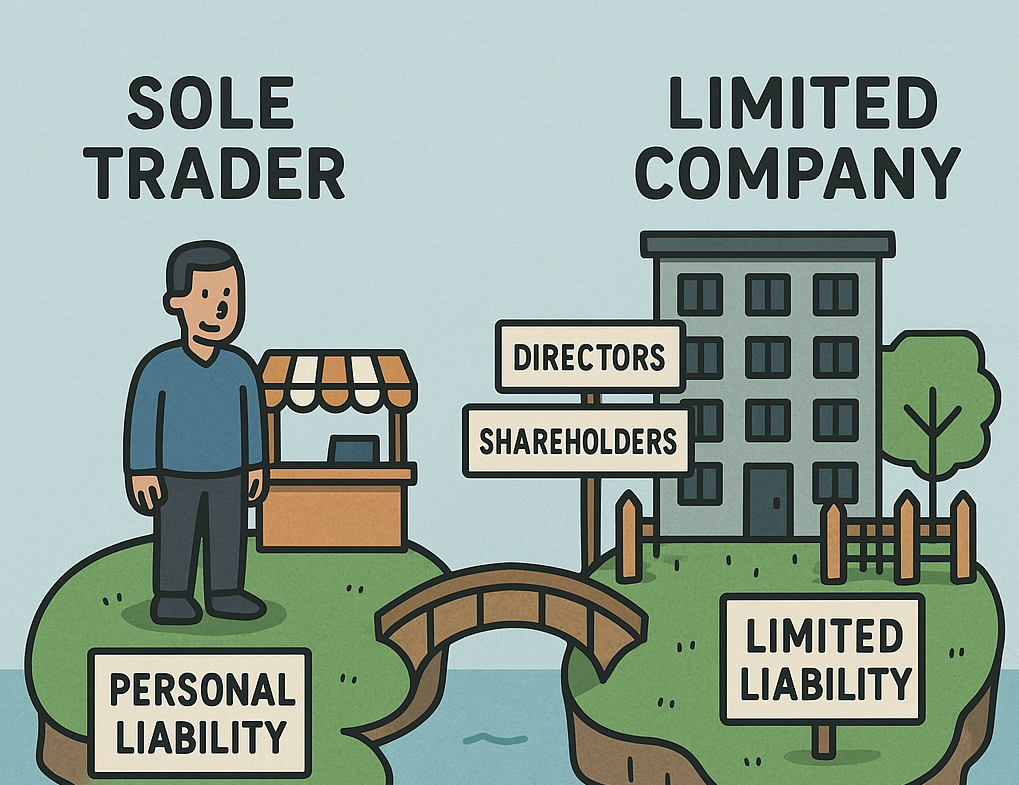
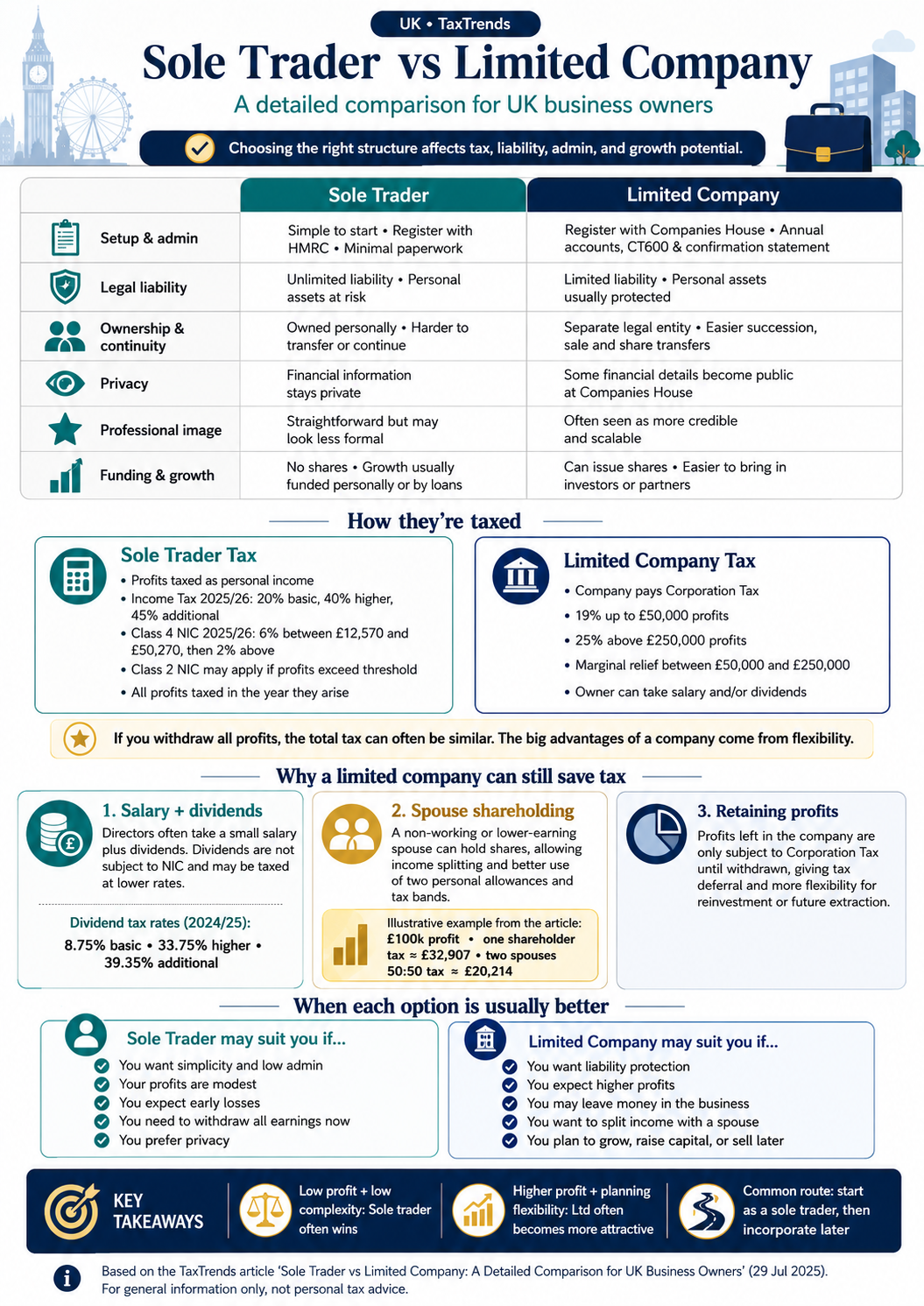
A sole trader is the simplest form of business ownership. Legally, there is no separation between you and the business, so you keep the profits after tax but are also personally responsible for the business's debts and obligations. Administration is relatively light: you keep business records, complete Self Assessment and, where relevant, comply with VAT, PAYE and Making Tax Digital requirements.
A limited company is a separate legal person registered at Companies House. Its shareholders normally benefit from limited liability, although directors can still become personally exposed through personal guarantees, wrongful conduct or other specific circumstances. The trade-off is more compliance: annual accounts, a Corporation Tax return, confirmation statements, payroll where salaries are paid, dividend paperwork and directors' statutory duties.
Legal liability and protection
A sole trader has unlimited liability, so business debts and claims can potentially affect personal assets. Insurance can reduce some commercial risks, but it does not create a legal separation between the business and its owner. A company normally creates that separation: the company owns its assets, enters contracts and incurs liabilities in its own name.
Limited liability is not absolute. Banks and landlords may require personal guarantees, and directors have statutory responsibilities when a company is insolvent or approaching insolvency. Even so, for a business with meaningful contractual, borrowing or litigation risk, the company structure can provide a materially different risk profile from sole trading.
How the two structures are taxed in 2026/27
Sole trader
For England, Wales and Northern Ireland, the 2026/27 Personal Allowance is £12,570 and is withdrawn by £1 for every £2 of adjusted net income above £100,000. The main Income Tax rates remain 20%, 40% and 45%. A sole trader also pays Class 4 National Insurance at 6% on profits between £12,570 and £50,270 and 2% above £50,270. Mandatory Class 2 contributions are no longer charged simply because profits exceed the lower profits limit, although voluntary Class 2 can still be relevant in some circumstances.
This means the tax cost rises quickly as profits move through the higher-rate bands and the Personal Allowance taper. A sole trader is taxed on the profit for the year whether the cash is withdrawn from the business bank account or left there for working capital, so simply retaining cash does not defer the owner's personal tax.
Limited company
A company pays Corporation Tax on taxable profits. For the financial year beginning 1 April 2026, the small profits rate is 19% for profits of £50,000 or less and the main rate is 25% for profits above £250,000, with marginal relief between those limits. The thresholds are reduced where there are associated companies and can also be apportioned for short accounting periods.
Extraction creates the second layer of tax. Salary is deductible for Corporation Tax but can trigger PAYE and employee and employer National Insurance. For 2026/27, the employer NIC rate is 15% above the £5,000 secondary threshold, while the employee primary threshold remains £12,570. Dividends are paid from post-Corporation-Tax profits and are not subject to NIC, but the 2026/27 dividend rates have increased to 10.75% for basic-rate taxpayers and 35.75% for higher-rate taxpayers, with the additional rate remaining 39.35%. The Dividend Allowance is £500.
The old rule of thumb that a director should simply take a salary equal to the Personal Allowance is no longer a universal answer. Employer NIC now starts at £5,000 and is charged at 15%, so the most efficient salary can depend on Corporation Tax, Employment Allowance eligibility, other employees, pension planning and the director's wider income.
Why a company can still be useful
Retaining profits
A company lets you leave post-Corporation-Tax profits inside the business without immediately paying dividend tax. That can be valuable if the business is building cash reserves, investing in growth or if you simply do not need all the profit personally. A sole trader does not have the same deferral: the year's business profit is taxed on the owner even when the money stays in the business.
Deferral is not the same as exemption. When retained cash is eventually extracted there may be dividend, salary or capital-gains consequences, and large non-trading cash balances can affect some reliefs. The benefit is the ability to choose the timing and method of extraction rather than being taxed personally on all profits as they arise.
A spouse or civil partner as shareholder
A genuine shareholding held by a spouse or civil partner can allow dividends to be spread across two taxpayers, potentially using two Personal Allowances, two Dividend Allowances and more than one basic-rate band. Transfers of assets between spouses and civil partners living together are generally made on a no-gain/no-loss basis for Capital Gains Tax, although the company-law and tax consequences of any share transfer still need to be documented properly.
The shareholder must actually own the shares and the arrangement must reflect genuine legal rights. Paying salary to a non-working spouse is a different issue: remuneration should be commercially justifiable for work actually performed. The calculator below therefore separates the number of shareholders receiving dividends from the number of directors receiving salary.
Company pension contributions
An employer pension contribution can be particularly useful for an owner-managed company. A qualifying company contribution can reduce taxable company profit and is not restricted by the director's relevant UK earnings in the same way as personal pension tax relief, although the pension annual allowance and the wholly-and-exclusively test still need to be considered. For a sole trader, personal tax relief is generally limited by relevant UK earnings and pension contributions do not reduce Class 4 NIC on the underlying trading profit.
When staying a sole trader can be better
A sole trader structure remains attractive where profits are modest, the business is low-risk and most of the cash needs to be spent personally. There are no company accounts, confirmation statements, dividend minutes or Corporation Tax filings, and the absence of a second layer of company-plus-shareholder taxation can make the numbers surprisingly competitive.
Loss relief can also be important for a new venture. Subject to the detailed rules, an individual trading loss may sometimes be relieved against other income or carried back, whereas a company's loss belongs to the company. If the business expects initial losses or the owner already has employment income, that difference can matter more than the headline tax rates.
2026/27 Sole Trader vs Limited Company tax simulator
The simulator below compares the two structures using 2026/27 England, Wales and Northern Ireland rates. It assumes no other personal income, an equal dividend split between shareholders, no student loans, no High Income Child Benefit Charge, no pension contributions and no Employment Allowance. Corporation Tax thresholds assume a 12-month accounting period and no associated companies.
For the limited-company case you can choose how many shareholders receive dividends, how many directors receive salary and the salary paid to each salaried director. This is intentionally more realistic than simply assuming that every shareholder receives a £12,570 salary.
Sole Trader vs Limited Company — 2026/27
Illustrative comparison using current tax rates and a simplified owner-managed-company model. Use the assumptions below as a planning guide rather than a filing computation.
A practical decision framework
Start with risk and commercial requirements, not tax. If limited liability, investors, customer procurement rules or succession make a company desirable, tax is only one part of the decision. If those factors are neutral, run the numbers using realistic assumptions about how much cash you will actually draw, not an artificial assumption that every pound of profit is immediately distributed.
Then test the non-tax costs. Accountancy fees, payroll, Companies House compliance, bookkeeping discipline and administrative time all have an economic value. A tax saving of a few hundred pounds can disappear quickly if the company structure adds materially more annual cost and complexity.
Conclusion
In 2026/27 there is no single profit level at which everyone should incorporate. A sole trader can be more efficient where profits are modest and all cash is needed personally, while a limited company can become more attractive where profits can be retained, a spouse or civil partner genuinely owns shares, employer pension contributions are valuable, or commercial risk makes limited liability important.
The best comparison is therefore a scenario analysis rather than a slogan. Use the calculator as a starting point, then factor in other income, Scottish rates where relevant, Employment Allowance eligibility, pension planning, student loans, benefits and the cost of running the company before changing structure.
Sources and further reading
- HMRC: Income Tax rates and allowances
- HMRC: National Insurance rates and allowances
- HMRC: Corporation Tax rates
- HMRC: tax on dividends
- TaxTrends – 10 Reasons why it's still worth going Limited
- Starling Bank – Sole trader or limited company
- Hibberts Solicitors – Ltd vs Sole Trader
- PensionBee – Sole trader vs limited company