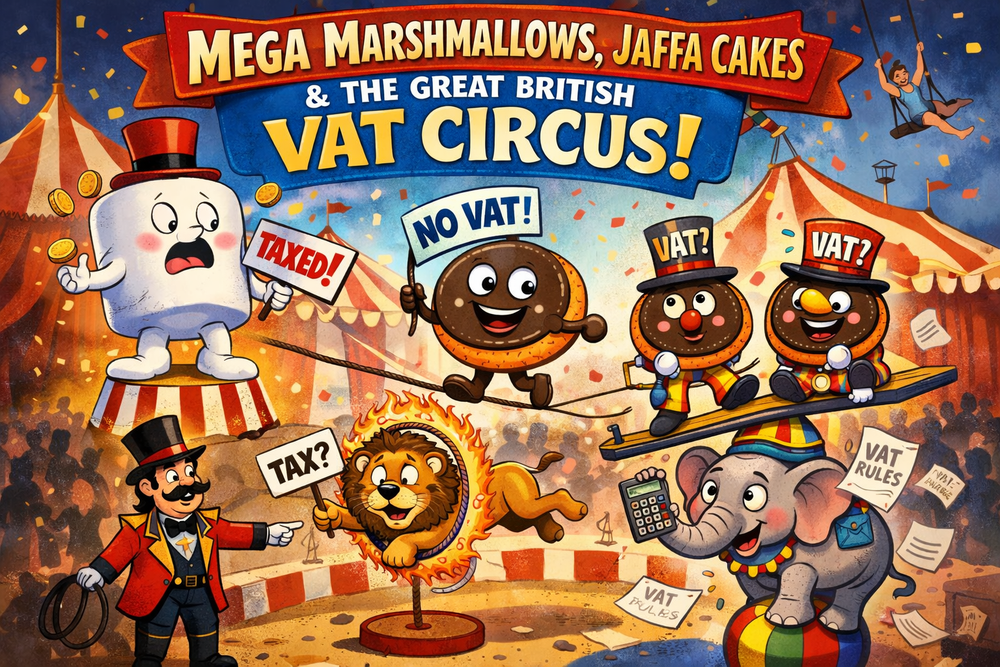
Mega Marshmallows, Jaffa Cakes, and the Great British VAT Circus
If you ever wondered what happens when a tax system designed in 1973 meets a product designed for a barbecue in 2025, the answer is four tribunal hearings, a Court of Appeal detour, a "natty mathematical formula," and a £470,000 hole in HMRC's trousers.
This week, the First-Tier Tribunal once again sided with Innovative Bites Limited, the makers of Mega Marshmallows, in a dispute so long-running it now qualifies for its own Netflix documentary. The crux of the case? Whether a marshmallow big enough to require a skewer is "confectionery" (standard-rated at 20% VAT) or "food" (zero-rated, and therefore a gift from heaven).
The winning argument, in all its majestic absurdity: Mega Marshmallows are not normally eaten with the fingers. They are roasted, toasted, skewered, and — one assumes — occasionally set on fire by an uncle who has had too much prosecco. Therefore, they are not sweets. Therefore, no VAT. Therefore, HMRC loses.
Four hearings. Barristers on both sides. Hundreds of thousands in costs. All to decide whether a big marshmallow is a small marshmallow's bigger cousin or a completely different animal in the eyes of the taxman.
If this sounds familiar, it should.
Flashback: The Jaffa Cake, the original VAT sitcom
In 1991, McVitie's found itself on the same tragicomic stage. HMRC — then Customs & Excise — decided that Jaffa Cakes were not cakes at all, but chocolate-covered biscuits. This mattered, because cakes are zero-rated, while chocolate-covered biscuits are standard-rated. A lot of money hinged on one spongy orange disc.
McVitie's response was glorious. Instead of dusty legal arguments, they baked a giant twelve-inch Jaffa Cake and wheeled it into the tribunal to prove that a Jaffa Cake is, in essence, a cake that has been shrunk. They then ran the now-legendary "stale test": biscuits go soft when stale; cakes go hard. Jaffa Cakes go hard. Case closed. Zero-rated.
It was possibly the most delicious piece of litigation in British legal history. And it established a principle that has haunted tribunals ever since: when in doubt, call a baker.
So let's get this straight…
British VAT food law, as enforced today:
- A marshmallow you eat with your fingers at a kid's birthday party: 20% VAT. Decadent. Taxable. Sinful.
- The same marshmallow, but bigger, because you're going to set it on fire in the garden: 0% VAT. Wholesome. Nutritious. Practically a salad.
- A chocolate-covered biscuit: 20% VAT. How dare you.
- A cake covered in chocolate: 0% VAT. Please, have another slice.
- A Jaffa Cake (which is neither fully a cake nor fully a biscuit and has basically lied on its passport): 0% VAT, but only after a multi-year court battle and the sacrificial baking of a twelve-inch prototype.
- A Pringle, which Procter & Gamble once tried to argue wasn't really a potato crisp because it was only 42% potato: 20% VAT. The Court of Appeal ruled they were crisps "in substance." Potatoes don't get to reinvent themselves just because they've been into yoga.
- A flapjack: usually 0% VAT.
- A cereal bar that looks like a flapjack, tastes like a flapjack, and is bought by the same person who would have bought a flapjack: 20% VAT. Because reasons.
Every single one of these distinctions has been argued, at length, in front of real judges, by real barristers, at real public expense.
The actual, honest-to-goodness rule
The law is Schedule 8, Group 1 of the Value Added Tax Act 1994. Food is zero-rated. But there's a list of "excepted items" which are standard-rated (including confectionery). And then there's a list of items that are excepted from the excepted items (cakes and biscuits not wholly or partly covered in chocolate).
It is, in other words, a tax designed by someone who really enjoyed Russian dolls.
The result is that HMRC officers and taxpayers have to argue — in court, on the record — about whether a thing is "normally eaten with the fingers," how sticky it is, whether it goes hard when stale, what percentage potato it contains, and whether it's intended to be roasted or just looked at longingly.
None of this generates economic activity. None of it helps a single child learn to read. None of it cures disease. It exists because in 1973 someone drew a line between "food" and "sweets" and then spent fifty years refusing to admit the line was drawn in butter.
The real scandal isn't the marshmallow. It's that nothing ever changes.
Every few years, a case like this rolls into the papers. Everyone has a good laugh. Accountants tweet about it. A junior minister promises to "look at simplifying VAT on food." And then… nothing.
The Office of Tax Simplification existed for a decade and was quietly abolished in 2022 without having simplified very much at all. The Treasury loves VAT because it raises enormous amounts of money. Everyone else loves the exemptions because taking zero-rating off food would be a political cyanide pill. And so the tribunals grind on, arguing about the finger-edibility of a giant marshmallow while the actual cost of running the tax system balloons.
The marshmallow case alone: four hearings, a Court of Appeal detour, and £470,000. That's £470,000 of public money spent to lose an argument about whether you need a stick to eat something.
If you made this up, no one would publish it. As satire it's too broad. As farce it's too expensive. As policy it's… apparently fine, actually. Let's do it again next year with a new product. I'm taking bets on the next VAT case now: my money is on giant gummy bears (too big to swallow whole, therefore not confectionery) or artisan vegan marshmallows (are they even marshmallows without gelatin? Discuss, for £800k and the next three years of your life).
What this means if you're actually running a food business
Behind the jokes, there's a serious point for anyone selling anything remotely borderline:
- Don't assume HMRC's view is the final word. Innovative Bites lost early rounds and kept going. If the economics justify it, appeal.
- Documentation matters. The Mega Marshmallow case hinged on how the product is actually used — packaging, marketing, shelving in supermarkets (the BBQ aisle, not the sweets aisle), recipes on the back. All of this was evidence. Build your paper trail from day one.
- Get advice before you launch. A VAT liability review on a new product line costs a few hundred pounds. A VAT tribunal costs a few hundred thousand. Choose wisely.
- Borderline is a feature, not a bug. If your product might qualify for zero-rating, it's worth the conversation. A 20% margin swing on retail food products can be the difference between a business and a hobby.
And if you're ever sitting in a meeting where someone asks, "Do you think we need to worry about VAT on this?" — the answer, based on fifty years of case law, is always yes.
Got a product that lives somewhere in the grey zone between "food" and "confectionery"? Don't wait for HMRC to send you a love letter. Get in touch and we'll help you build the case before anyone has to bake a giant anything.