

Across Europe, the political weather is shifting towards higher taxes—and taxpayers with options are paying attention. In Britain, Labour has gone all-in on raising more revenue: dividend tax rates rose in April 2026, higher property-income rates are coming, and the tax take is forecast to reach around 38% of GDP. Across the Channel, La France Insoumise's radical tax-and-redistribution agenda has found a particularly receptive audience among younger voters; one Elabe poll put LFI first among 18–24-year-olds in a hypothetical legislative election.
Whether you see that as overdue fairness or a warning sign, the practical consequence is the same. Entrepreneurs, investors, freelancers and pensioners are increasingly asking whether they should keep their lives and capital anchored to countries where the direction of travel appears to be only one way.
For those able and willing to move, the grass can genuinely be greener—but only if the new residence works for the income they actually have, and the country they leave behind accepts that they have really gone. That makes residence planning part of the destination decision, not an afterthought.
The short answer
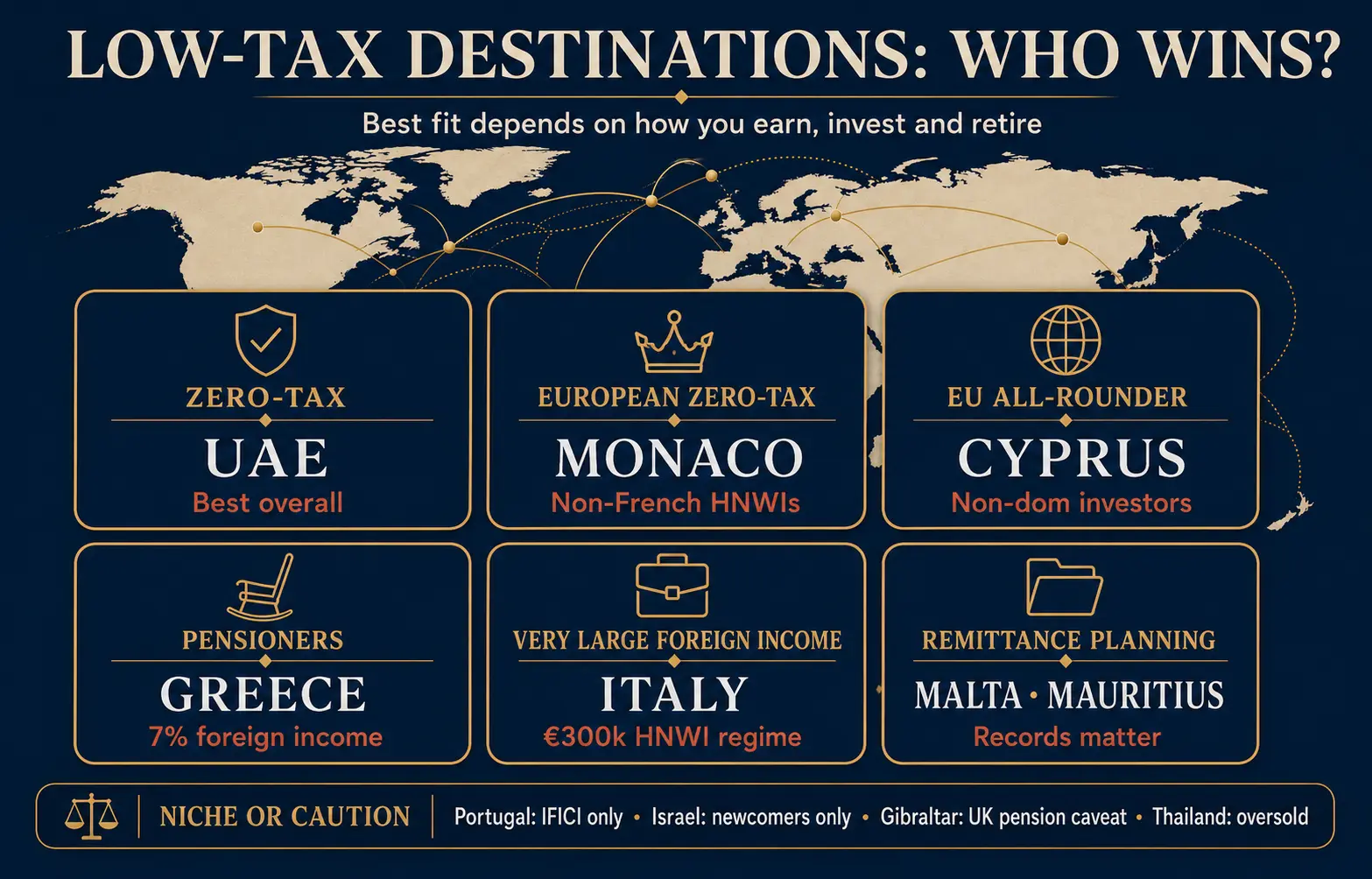
There is no single “best low-tax country”. There are several winners for different taxpayers:
- Best all-round zero-tax destination: the UAE, provided the move is real and a freelancer models UAE corporate tax rather than assuming that “Dubai is tax free”.
- Best European zero-tax destination for non-French HNWIs: Monaco, especially for investment income and gains. Most French nationals remain within French income tax and IFI, but genuine residents can still obtain succession-tax and social-security advantages. UK pensions remain exposed to UK tax because there is no UK–Monaco DTA.
- Best all-round EU destination: Cyprus, particularly for a non-domiciled investor or owner-manager. It combines no Special Defence Contribution on dividends and interest for non-doms, broad exemption for securities gains and a 5% foreign-pension option.
- Best simple pensioner regime: Greece, with 7% on total foreign income for up to 15 years. Italy's 7% regime is competitive but geographically narrower.
- Best for very large foreign income: Italy's HNWI regime, which replaces Italian tax on covered foreign income with a fixed €300,000 annual charge for new 2026 entrants, potentially for up to 15 years. It is compelling only when the foreign tax saving comfortably exceeds the charge.
- Best for disciplined remittance-basis planning: Malta or Mauritius. Both require clean segregation of capital and income; neither makes locally performed freelance work foreign-source.
- Best for an eligible 2026 immigrant: Israel, but only for a new immigrant or qualifying long-term returning resident. Without immigrant relief, Israel is a high-tax country.
- Best for a qualifying professional: Italy's impatriate regime or Greece's Article 5C, depending on eligibility and where the work is performed.
- Former favourite, now a niche option: Portugal. IFICI can still benefit a limited group of researchers, innovators and specified professionals, but Portugal is no longer a general low-tax destination for new retirees, investors or freelancers.
- Best for an older pensioner already comfortable with UK-source taxation: Gibraltar can be attractive domestically, but its treaty permits the UK to tax UK-arising pensions. It is not a UK-pension-lump-sum escape route.
- Most oversold: Thailand. Since 2024, post-2023 foreign income remitted while Thai-resident can be taxable even if remitted later, and the old UK–Thailand treaty contains no general private-pension article.
The first planning question is therefore not “which country has the lowest headline rate?” It is: what type of income will you have, where will the work be performed, when will cash be remitted, and could the country you leave still treat you as resident or claw the tax back later? That residence analysis comes before comparing destination tax rates.
Use our UK Statutory Residence Test Tracker to monitor your UK days, workdays and ties as you plan and manage your move overseas.
Comparison at a glance
| Country | Work income | Dividends & interest | Capital gains | Pensions / lump sums | Best fit |
|---|---|---|---|---|---|
| UAE | No personal income tax; UAE business activity can enter corporate tax above the natural-person turnover threshold | Normally 0% personally | Normally 0% personally | Normally 0% in the UAE; treaty classification and UK temporary non-residence still matter | Mobile investors, retirees and high-margin consultants |
| Monaco | No personal income tax for genuinely established non-French residents; most French nationals remain within French income tax, although Monaco social-security costs may be lower | Normally 0% in Monaco for non-French residents | No general personal capital-gains tax | 0% in Monaco, but the UK can still tax UK pensions and lump sums because there is no UK–Monaco DTA | Non-French HNWIs; selected French succession and social-security cases |
| Cyprus | Ordinary income-tax rates apply to work; the attraction is the non-dom regime for investment income | Qualifying non-doms pay no SDC on dividends and interest; GHS can still apply | Qualifying securities gains are generally exempt | Foreign pensions can generally use 5% above €3,420; verify lump-sum classification | Non-dom investors and owner-managers wanting an EU base |
| Malta | Work performed in Malta is Malta-source and ordinarily taxed | Foreign income is taxed when remitted; special residence programmes commonly use 15% | Foreign capital gains can remain exempt even when remitted | Treaty treatment can be favourable; obtain classification before a large commutation | Investors able to segregate capital, income and gains |
| Israel | The attraction is the newcomer relief: eligible 2026 arrivals may receive graduated relief on qualifying Israeli earned income | Eligible new immigrants and veteran returners can receive a ten-year foreign-source exemption | Eligible foreign gains can fall within the ten-year exemption | A genuinely foreign pension can fall within eligible immigrant relief | Eligible new immigrants and long-term returning residents only |
| Italy | Qualifying impatriates can exclude 50% of eligible Italian employment or professional income | The HNWI regime replaces tax on covered foreign income with a €300,000 annual charge | Covered foreign gains can fall within the HNWI fixed-tax election | Eligible pensioners in qualifying towns can pay 7% on foreign income | Southern-town pensioners, qualifying professionals and very high foreign incomes |
| Greece | Article 5C exempts 50% of qualifying Greek employment or individual-business income for seven years | Article 5A can cap tax on foreign income; Article 5B covers foreign income of eligible pensioners | Foreign gains can be covered by the elected special regime | Article 5B charges 7% on total foreign income for up to 15 years | Mediterranean pensioners, HNWIs and qualifying freelancers |
| Portugal | IFICI gives 20% on eligible Portuguese employment and self-employment income | IFICI can exempt qualifying foreign investment income | IFICI can exempt qualifying foreign gains | IFICI does not exempt pensions; old NHR treatment is only for protected entrants | Researchers, innovators and specified professionals—not generic retirees |
| Gibraltar | HEPSS taxes qualifying senior executives on capped assessable income | Category 2 caps assessable income for qualifying HNWIs | No general capital-gains tax | Local pension income can be 0% from age 60, but the UK may still tax UK pensions | Category 2 HNWIs, HEPSS executives and pensioners with suitable pension sources |
| Thailand | Work physically performed in Thailand is Thai-source and taxable | Foreign income earned while resident can be taxed when remitted | No standalone CGT; source and remittance classification matter | The UK treaty lacks a general private-pension article, creating possible double exposure | Lifestyle-led moves with controlled and well-documented remittances |
| Mauritius | Low ordinary bands apply; locally performed freelance work remains Mauritian income | Foreign income is generally taxed on remittance for individuals | Genuine capital gains are generally outside income tax | Treaty normally gives Mauritius taxing rights over private pensions; lump sums need confirmation | Investors and retirees able to manage remittances |
Rates alone do not include social security, health contributions, municipal taxes, VAT, property taxes, wealth taxes or immigration costs. They should therefore be treated as only one layer of the overall comparison.
1. UAE: still the cleanest zero-tax answer—with a freelancer caveat
The UAE imposes no general personal income tax on wages, dividends, portfolio gains or pensions. That makes it the clearest answer for a person living on investment income or drawing a private pension.
The mistake is to extend that statement automatically to consulting income. The Federal Tax Authority says a natural person is within corporate tax where they conduct a UAE business and total business turnover exceeds AED1 million in a calendar year. Wages, personal investment income and real-estate investment income are excluded from this test. Below the threshold there is no natural-person corporate-tax registration; above it, taxable business profit is normally taxed at 0% up to AED375,000 and 9% thereafter.
Small Business Relief can deem an eligible resident person to have no taxable income where revenue is no more than AED3 million, but the present relief only covers tax periods ending by 31 December 2026. It should not be built into a long-term forecast without assuming expiry.
A free-zone licence is not a magic 0% certificate. A Qualifying Free Zone Person receives 0% only on qualifying income and 9% on non-qualifying income, subject to activity, substance, transfer-pricing and de minimis conditions. Many one-person service businesses are better analysed under the ordinary rules.
For a UK private pension, Article 17 of the UK–UAE treaty normally allocates pensions and similar remuneration to the state of residence. UK government-service pensions follow different rules. Before payment, obtain UAE treaty residence evidence and make any HMRC relief-at-source claim. A residence visa alone does not prove treaty residence. For a fuller treatment of the departure-year, treaty, company and return-to-UK issues, see our guide to moving from the UK to the UAE.
2. Monaco: zero tax for most—plus narrower benefits for French nationals
Monaco is one of the strongest personal-tax destinations in Europe for a genuinely established resident who is not French. The Principality does not impose personal income tax on most residents, so salary, self-employment income, dividends, interest, pensions and portfolio gains are generally outside Monegasque personal income tax. It also has no general personal capital-gains tax or net wealth tax. Source-country taxes can still apply, and Monaco's absence of tax does not override another country's residence rules.
The French exception is decisive, but it does not eliminate every advantage. Under the 1963 Franco-Monegasque convention, most French nationals moving to Monaco remain subject to French income tax on worldwide income as though resident in France. The historic exceptions are extremely narrow. A second nationality does not rescue a new arrival: the special treatment for certain dual nationals is limited to people who moved to Monaco before 29 December 1995 and satisfied additional conditions. French nationals who moved to Monaco from 1 January 1989 are also generally exposed to French IFI on worldwide real estate as though resident in France.
There are nevertheless two important qualifications for a French national who genuinely lives in Monaco. The main ones concern social contributions and succession tax:
- Social levies and social security. The convention's deemed French residence applies to income tax; it does not by itself impose CSG, CRDS or the other French social levies. These can still apply where the person independently meets France's domestic residence tests, or to relevant French-source income, but Monaco and foreign investment income do not enter the French social-levy net solely because of the convention. Someone working in Monaco instead contributes to Monaco's social-security system—the closest equivalent to National Insurance. Depending on employment status, remuneration and supplementary pension coverage, the total cost can be materially below the French system. Self-employed people pay under Monaco's separate health and pension schemes, so the comparison must be modelled rather than assumed.
- Succession tax. The 1950 France–Monaco succession convention treats a French national as Monaco-domiciled for inheritance-tax purposes after at least five years of habitual Monaco residence. Shares, securities, bonds, receivables and other qualifying intangible assets are then generally taxable only in Monaco, where transfers to a spouse or direct descendants can be exempt. French real estate remains taxable in France, tangible property is generally taxed where situated, and the treaty does not cover lifetime gifts. For a French HNWI with a large financial portfolio, this can be a substantial benefit despite the continuing French income-tax and IFI exposure.
Residence must be real. A foreign applicant needs a valid residence card and a genuine Monaco home. For a tax-formality residence certificate, the official rules require evidence of the main place of stay, home or main centre of activities. The main-place-of-stay test is normally at least 183 days in Monaco, or fewer days only where Monaco still exceeds time spent in every other country. The authorities can request the lease or title, utility and telephone bills and other evidence. This is particularly important for someone retaining a substantial home, family or business activity in the UK or France.
For a UK pension, Monaco is materially weaker than the UAE. Monaco itself does not tax the payment, but the UK and Monaco have no double-tax agreement. A UK pension therefore remains exposed to UK domestic taxation, with no residence-state treaty article to shift the taxing right to Monaco. The normal UK tax-free element may still apply under UK pension rules, but Monaco is not a treaty route for withdrawing the taxable balance free of UK tax. Temporary non-residence must also be tested if a return to the UK is possible.
Active freelancers need a separate business analysis. Carrying on an activity in Monaco requires authorisation and can bring social-security costs. Monaco's 25% profits tax applies to industrial or commercial enterprises where at least 25% of turnover comes from operations outside Monaco, as well as certain intellectual-property income. A consultant billing mainly foreign clients should not extrapolate the personal 0% rate to the business without confirming the activity's legal and tax classification.
3. Cyprus: the non-dom regime is the attraction
Cyprus belongs on this list because of its non-dom regime, not because ordinary employment income is lightly taxed. It is particularly efficient for investors and owner-managers receiving dividends.
A person satisfying the 183-day rule—or the more demanding 60-day rule—can be Cyprus-resident. The 60-day route requires, among other things, no residence elsewhere, no more than 183 days in another state, a permanent Cyprus home and Cyprus employment, business or office.
The crucial benefit is non-domicile status. Cyprus Special Defence Contribution (SDC) applies mainly to dividends and passive interest received by a person who is both resident and domiciled. A qualifying non-dom therefore pays no SDC on those items, normally until deemed domicile arises after 17 of the previous 20 tax years. The General Healthcare System contribution can still apply—commonly 2.65% on dividends, interest and pension income, subject to the contribution base cap. For domiciled residents, dividend SDC on post-2025 profits is now 5%.
Gains from disposing of qualifying securities are generally exempt. Cyprus CGT at 20% is focused chiefly on Cyprus immovable property and shares deriving value from it.
Foreign pension income can generally be taxed at ordinary rates or, by annual election, at 5% on the amount above €3,420. The UK–Cyprus treaty generally gives Cyprus the taxing right over a UK private pension. A full encashment must still be classified: do not assume that every UK lump sum is automatically a “foreign pension” eligible for 5%.
For a freelancer, the usual comparison is direct self-employment—progressive tax plus social and health charges—against a Cyprus company paying 15% and distributing post-tax profit to a non-dom shareholder, normally with GHS on the dividend. Salary, transfer pricing, VAT, company substance and where decisions are made must be modelled.
4. Malta: powerful remittance basis, unforgiving record-keeping
A person who is resident in Malta but not domiciled there is normally taxed on Malta-source income and on foreign income only to the extent remitted to Malta. Foreign capital gains remain outside Malta tax even if remitted. This is more valuable than a headline low rate—but only for someone who can distinguish clean capital, income and gains.
The guidance also contains the trap: remittances used for ordinary living expenses are presumed to be income unless the taxpayer proves otherwise. Profession or self-employment income generally arises where the activity is carried out, so a consultant working from a Maltese home cannot leave fees offshore and call them foreign income.
Ordinary personal rates reach 35%. Non-doms with at least €35,000 of foreign income can face a €5,000 minimum annual tax, subject to exceptions and double-tax relief. Special residence programmes commonly tax remitted foreign income at 15%, impose a minimum and tax Malta-source income at 35%.
The UK–Malta treaty generally allocates private pensions to Malta. Maltese law can exempt a capital sum received by way of commutation of a pension, but the scope depends on the scheme and payment. A UK SIPP full withdrawal should be cleared in writing before crystallisation; a label used by the UK provider does not bind Malta.
Malta companies pay 35% nominally. A shareholder refund after a dividend can reduce the effective tax on qualifying trading profits to roughly 5%, but this is not a 5% headline company rate: cash-flow, audit, refund timing, anti-abuse rules and real management all matter.
5. Israel: a tax haven only for the right new arrival
Israel belongs on this list only because its newcomer regime can be exceptionally generous. Outside that regime, it is not a low-tax destination.
For an eligible arrival, the exception is substantial. A new immigrant or veteran returning resident—typically someone away for at least ten years—can receive a ten-year exemption and reporting exemption for foreign-source income, including foreign business income, dividends, interest, gains and pensions.
For eligible people arriving from 5 November 2025 to 31 December 2026, Israel introduced additional graduated relief for eligible Israeli income from personal effort for up to five years, subject to annual caps. Passive Israeli income such as rent, interest and dividends is not covered.
The source boundary is decisive. Consulting physically performed in Israel may be Israeli-source even if clients and bank accounts are abroad. The immigrant exemption does not transform local work into foreign work.
The UK–Israel treaty generally places private pensions in the residence state; government pensions differ. Eligible immigrant relief can then exempt a genuinely foreign pension in Israel. Closely held-company rules introduced from 2025—including charges or distribution expectations for accumulated profit in affected companies—make “leave everything inside my company” less reliable.
6. Italy: three relocation regimes are the whole story
Italy is included because of three targeted relocation regimes—not because its ordinary tax system is low-tax. The relevant question is which, if any, of these regimes fits:
- Foreign pensioners: eligible recipients moving to qualifying smaller municipalities in southern Italy and certain earthquake-affected areas can pay 7% on all foreign-source income for up to nine tax periods. They generally must not have been Italian resident in the previous five tax years and must move from a cooperative state. Italian-source consulting remains ordinarily taxed.
- High-net-worth new residents: a person non-resident in at least nine of the previous ten years can elect a fixed tax on foreign income. For moves from 1 January 2026 it is €300,000 per year, plus €50,000 per covered family member, for up to 15 years. This only makes economic sense where annual foreign tax saved comfortably exceeds the fixed charge.
- Impatriate workers and professionals: qualifying post-2023 arrivals can generally include only 50% of up to €600,000 of eligible Italian employment/professional income for the transfer year and four following tax periods, with residence, qualification and prior non-residence conditions.
The UK–Italy treaty generally assigns private pensions to Italy. Whether a UK lump sum is foreign pension income within the 7% regime should be confirmed before payment.
An offshore company is not a shield where the owner makes strategic decisions from Italy. Italian corporate residence, permanent establishment, CFC and beneficial-owner rules can override the incorporation address.
7. Greece: three regimes built specifically for new residents
Greece has built three clearly targeted regimes. Each is aimed at a different type of incoming taxpayer:
- Article 5B pensioners: 7% on total foreign-source income—pension, dividends, interest, rent and gains—for up to 15 tax years. The applicant needs foreign pension income, must not have been Greek-resident in five of the previous six years and must move from a state with administrative tax cooperation.
- Article 5A HNWIs: €100,000 annually on all foreign income, €20,000 per relative, up to 15 years, generally with a €500,000 Greek investment and prior non-residence conditions.
- Article 5C workers/self-employed: 50% exemption for seven years on qualifying Greek employment and individual business income, with prior non-residence and at least a two-year commitment.
These terms are set out in the Greek tax authority's official 5A/5B/5C guide. Eligibility should still be checked against the taxpayer's own facts before relying on the regime.
Outside these regimes Greece is not especially low-tax, so the analysis should start with eligibility for 5A, 5B or 5C. Self-employed applicants must also model Greece's presumptive-income rules.
The 1953 UK–Greece treaty is old and includes subject-to-tax mechanics. A Greek-resident pensioner paying the 7% levy should obtain a Greek residence certificate and handle UK relief before drawing a large pension. Government-service pensions need separate analysis.
8. Portugal: NHR is over; IFICI is narrower but still valuable
Portugal's old Non-Habitual Resident regime closed to most new arrivals from 1 January 2024. Transitional entrants and existing beneficiaries can retain it, including the 10% foreign-pension treatment, but it should not be advertised to an ordinary 2026 mover.
The replacement, IFICI, is for specified research, innovation, technology, investment and highly qualified roles with eligible organisations. It requires no Portuguese residence in the preceding five years and can apply for ten years. Eligible Portuguese employment and self-employment income is taxed at 20%.
IFICI can exempt many qualifying foreign-source categories—employment, business, investment, property and gains—but not Category H pensions. Ordinary residents face progressive income tax up to 48%, solidarity surcharge at higher incomes and a common 28% rate for dividends, interest and many securities gains.
There is a valuable but dangerous pension nuance. In one Portuguese binding ruling, a complete one-off foreign pension withdrawal was classified as Category E investment income rather than Category H pension income. A qualifying IFICI taxpayer might therefore argue for foreign-income exemption. That ruling is fact-specific; it is a reason to seek a pre-withdrawal ruling, not permission to generalise.
The new 2025 UK–Portugal treaty became effective for Portuguese tax from 1 January 2026 and UK income tax/CGT from 6 April 2026. It generally allocates private pensions to residence, but classification remains essential.
For companies, the standard IRC rate is 19% in 2026; qualifying SMEs can access 15% on the first €50,000 of taxable profit. The company position should be modelled separately from the individual's relocation regime.
9. Gibraltar: Category 2 and HEPSS are the main attractions
Gibraltar taxes income accruing in or derived from Gibraltar. It has no general capital-gains tax, and passive investment income can be favourable, but ordinary work is taxable under the Allowances Based System or Gross Income Based System.
Two statuses matter for internationally mobile high earners. They target different profiles:
- Category 2: current assessable income is capped at £118,000, producing minimum and maximum annual liabilities of £37,000 and £42,380. For new applicants, the government announced a higher £5 million net-wealth requirement and £5,000 application fee in June 2026; existing holders are grandfathered.
- HEPSS: qualifying senior executives with specialist skills are taxed under GIBS on capped assessable income of £160,000, currently producing about £39,940 tax.
Gibraltar pension income is taxed at 0% from age 60. But the UK–Gibraltar treaty says pensions and similar remuneration arising in a territory may be taxed in that territory. The UK can therefore tax a UK-arising private pension even where Gibraltar's domestic charge is nil. This makes Gibraltar materially less attractive for a planned large UK pension withdrawal than the UAE, Cyprus, Malta, Greece or Mauritius.
The company rate is 15% on profit accrued in or derived from Gibraltar. Incorporation alone does not create a 15% result; the location of management and income-generating activity determines source.
Anyone spending significant time over the border must also study the UK–Spain agreement on Gibraltar taxation. Spanish residence cannot be avoided simply by sleeping in Gibraltar while a spouse, permanent home or economic interests remain in Spain.
10. Thailand: remittance planning survived, but the old sales pitch did not
Thailand treats an individual as resident after at least 180 days in the calendar year. Thai-source income is taxed at progressive rates up to 35%. Since 1 January 2024, foreign income earned in a year when the individual is Thai-resident is taxable when remitted to Thailand—even if remitted in a later year. Pre-2024 foreign income and genuine capital remain important, but must be traceable.
This eliminates the old technique of waiting until the following year to remit income tax-free. It does not create full worldwide taxation on accrual: unremitted foreign income can remain outside the Thai charge under current rules. The practical planning is separate accounts for pre-2024 income, post-2023 income, gains and original capital, combined with foreign-tax-credit records.
Dividends from Thai companies are commonly subject to 10% withholding, which a resident may elect to treat as final. Securities gains have no separate CGT regime; gains that constitute assessable income can fall into PIT, although Thai-exchange and source rules create exemptions in particular cases.
The 1981 UK–Thailand treaty contains no general private-pension article. A UK private pension therefore does not receive the usual residence-only protection: the UK can continue taxing UK-source pension income, while Thailand can tax the remittance and normally give credit. A large lump sum is correspondingly poor planning without bespoke advice.
A consultant working from Thailand is performing Thai-source services regardless of client location. A foreign company may also acquire a Thai permanent establishment or local-management exposure; work-permit and foreign-business restrictions matter as much as the 20% company rate.
11. Mauritius: low rates, no general CGT and a useful remittance basis
Mauritius taxes resident individuals on worldwide income, but an individual's foreign-source income is generally taxed only when remitted. Genuine capital remittances and capital gains fall outside income tax, subject to evidence and the line between investment and trading. The MRA confirms that securities gains of a resident individual are treated as capital gains and not subject to income tax.
For the income year 1 July 2025 to 30 June 2026, individual rates are 0% on the first Rs500,000, 10% on the next Rs500,000 and 20% thereafter. A temporary 15% Fair Share Contribution applies above Rs12 million for the 2025/26 income year and the next two years. It includes resident-company dividends, although qualifying global-business distributions and specified pension commutations are excluded.
Dividends from a resident Mauritian company are exempt from ordinary income tax. Foreign dividends remitted to an individual are not automatically 3% income: the widely quoted 3% result is mainly a company calculation under an 80% partial exemption. The company must perform core income-generating activities in Mauritius, employ adequate qualified people and incur proportionate expenditure. The normal company rate is 15%.
Article 18 of the UK–Mauritius treaty generally makes private pensions taxable only in Mauritius; government pensions remain source-taxed, subject to nationality exceptions. Mauritius law contains exemptions for specified pension commutations, but a UK SIPP or other personal pension must meet the relevant definition or ruling. Confirm the domestic result before withdrawal.
For freelancers, fees for work performed in Mauritius are local business income even if invoiced through a UK or UAE company. The 20% personal rate may still be competitive, but corporate substance and social contributions need modelling.
The pension lump-sum trap: seven checks before pressing “withdraw”
A destination's pension rate is only one layer. Our guide to accessing a UK pension explains the main withdrawal methods; for an overseas move, use this sequence:
- Identify the payment legally. Is it a pension commencement lump sum, UFPLS, flexi-access drawdown, full commutation, annuity, scheme pension, QROPS payment or an unregistered arrangement?
- Establish residence on the payment date. Residence certificates and treaty tie-breakers matter; a visa, local tax number or rented flat is not enough.
- Read the exact treaty. HMRC notes that many treaties treat pensions and lump sums alike, but not all do. Gibraltar permits source taxation and Thailand lacks the usual private-pension article.
- Obtain destination classification. Malta's commutation exemption and Portugal's Category E ruling can be valuable, but neither applies merely because a UK provider calls a payment a lump sum.
- Arrange UK relief or refund. Use a certified residence claim where the treaty removes UK tax; otherwise emergency PAYE can create a large temporary cash cost.
- Test temporary non-residence. A treaty exemption in the withdrawal year does not necessarily prevent a UK charge on return.
- Model the whole extraction. A tax-free withdrawal may trigger loss of investment shelter, inheritance-tax changes, local wealth/property exposure or foreign-exchange risk.
Leaving the UK: why “fewer than 183 days” is not enough
UK residence is tested separately for each tax year under the Statutory Residence Test (SRT). Fewer than 183 days only avoids one automatic UK test; it does not prove non-residence.
For someone who was UK-resident in one or more of the previous three tax years, an automatic overseas result can arise with fewer than 16 UK days. Someone non-resident throughout all three previous tax years may use fewer than 46 days. The full-time-overseas test normally requires fewer than 91 UK days, no more than 30 UK workdays of more than three hours and no significant break from overseas work. If no automatic test settles the answer, the sufficient-ties test counts family, accommodation, work, 90-day and country ties.
Key traps need to be checked alongside the headline day count. In particular:
- Split year is not elective. It applies only if one of the statutory cases is satisfied. Our detailed guide to the eight split-year cases explains the conditions and common traps; otherwise the person can remain UK-resident for the entire departure year.
- A UK home can create accommodation ties. A spouse or minor children in the UK can create a family tie. Working more than three hours on 40 days can create a work tie.
- Companies do not emigrate with their shareholder. A UK company remains within UK corporation tax; a foreign company can become UK-resident if central management and control is exercised from the UK.
- UK land remains taxable. Non-residents remain taxable on UK rental income and gains on UK land, including some property-rich entities; our guide to UK taxation of non-residents covers the wider post-departure position.
- Dividends can return to bite. UK dividends are often outside further non-resident income tax, but distributions from a close company during temporary non-residence can be taxed on return.
The five-year temporary non-residence clawback
Broadly, the temporary non-residence rules can apply where a person was solely UK-resident in at least four of the seven tax years before departure and the period of non-residence is no more than five years. Certain gains, close-company distributions, offshore income and pension withdrawals received while away can be taxed in the year of return.
For post-5 April 2015 registered-pension withdrawals, relevant flexible withdrawals exceeding £100,000 in total during a temporary period of non-residence can be charged on return. HMRC's view is that the double-tax treaty applying in the withdrawal year does not block that later UK charge.
This is the single biggest problem with the “move abroad, empty the pension, come back” plan. If a UK return is plausible, the minimum-duration test and cash-flow should be designed before departure—not after the withdrawal.
France: 183 days is not a safe harbour either
France can treat an individual as resident if any domestic criterion is met: the household or principal place of stay is in France; the principal professional activity is in France; or the centre of economic interests is in France. A person can therefore be French-resident with fewer than 183 days where a spouse and family home remain there or the economic centre is French.
This matters particularly for someone claiming UAE, Monaco, Gibraltar, Mauritius or Maltese residence while spending substantial time at a French home. The practical questions are where the family lives, where homes are continuously available, where the business is directed, where the largest income and investments are managed and where daily life is centred.
If both countries claim residence, the applicable treaty normally looks in order at permanent home, centre of vital interests, habitual abode, nationality and competent-authority agreement. A residence certificate from the lower-tax country does not disapply French domestic law; it is evidence used in the treaty analysis.
French-source rent and real-estate gains can remain taxable, and French real estate can remain within IFI for a non-resident. A departure also requires an exit-tax review. The French exit tax can apply where the person was French-resident for at least six of the preceding ten years and owns relevant securities worth at least €800,000 or representing at least 50% of a company's profit rights. Payment can be deferred, with conditional relief commonly after two years where relevant securities are below €2.57 million and five years above it. Filing and monitoring continue after departure.
A practical decision table
| Taxpayer profile | First jurisdictions to model | Usually weaker choices | Why |
|---|---|---|---|
| Portfolio investor living on dividends and gains | UAE, Monaco, Cyprus, Malta, Mauritius | Israel without immigrant relief; ordinary Portugal | Zero tax, non-dom, remittance basis or no CGT |
| UK private pensioner taking regular income | UAE, Cyprus, Greece, Italy, Mauritius | Monaco, Gibraltar and Thailand | Residence-only treaty treatment plus low/zero destination rate |
| UK pensioner planning a very large lump sum | UAE first; Malta/Portugal only with a ruling; Cyprus/Greece after classification | Monaco, Gibraltar, Thailand; any short move back to UK | Treaty wording, local classification and UK temporary non-residence dominate |
| Active one-person consultant | UAE, Cyprus; Greece 5C; Italy impatriate; Portugal IFICI if eligible | Malta/Thailand if relying on offshore invoicing | Work is normally sourced where physically performed |
| HNWI with very large foreign passive income | UAE, Monaco, Cyprus, Greece 5A; Italy only if €300k fixed tax is economic | Gibraltar Category 2 if UK pension extraction is central | Compare fixed charge with actual foreign tax saved |
| Eligible new immigrant to Israel | Israel, then UAE/Cyprus as benchmark | Ordinary Israel after relief ends | Ten-year foreign-source exemption; special 2026 local earned-income relief |
| Wants EU residence and simple banking | Cyprus first; Greece/Italy by profile; Malta for remittance planners | Portugal unless IFICI-eligible | Cyprus has the broadest mix of dividend, gain and pension benefits |
The right order of work
The country should be selected only after building a five-column income map: employment, self-employment, company profit/dividends, investment gains and pension withdrawals. For each item record the legal owner, source country, likely payment date, destination classification and treaty article.
Then work through the sequence below before committing to the move. This makes the residence and tax assumptions explicit:
- Run the UK SRT for the departure year and at least the following three tax years, including worst-case travel and workdays.
- If France is relevant, document household, home, professional activity and economic-centre facts; do not rely on a day count alone.
- Test temporary non-residence assuming an unexpected UK return inside five years.
- Compare direct freelancing with a local company, including social charges, VAT, payroll, dividend tax, substance and management.
- Obtain advance local advice—or a binding ruling where available—before a large pension withdrawal or company distribution.
- Secure immigration status, a genuine home, local registrations and a treaty residence certificate.
- Keep a residence evidence file: travel log, work calendar, home records, utility use, family facts, local filings, banking and board decisions.
Final verdict
The UAE remains the cleanest all-round zero-tax jurisdiction. Monaco is its strongest European counterpart for genuinely resident non-French investors, but the absence of a UK–Monaco tax treaty makes it much weaker for UK pensions. For French nationals it is not an income-tax or IFI escape, although succession-tax and social-security savings can still be material. Cyprus is the most convincing low-tax EU alternative. Greece is the standout simple pensioner regime; Italy is excellent only when one of its specialist regimes fits. Malta and Mauritius reward disciplined remittance planning. Israel can be exceptional for eligible newcomers but is otherwise high-tax. Gibraltar is useful for Category 2 and HEPSS profiles but its UK pension treaty is a major limitation. Thailand is now a remittance-basis country with an unfavourable UK-pension treaty, not a pension tax haven. Portugal's old reputation rests on a regime that has closed; IFICI is valuable but narrow.
Most failed expatriation plans do not fail because the destination rate was misunderstood. They fail because the taxpayer continued working in the old country, left the family and home there, managed a company from the wrong place, misclassified a pension lump sum or returned too soon. The winning jurisdiction is the one whose rules still work under the taxpayer's real life—not the one with the lowest number in a brochure.
Official sources and further reading
- United Kingdom: Budget 2025 tax legislation and rates
- United Kingdom: House of Lords Library summary of Budget 2025
- France: Elabe legislative-election polling tables
- UAE: Federal Tax Authority: natural persons and corporate tax
- Monaco: French tax authority: personal taxation and the French-national exception
- Monaco: French tax authority: France–Monaco succession convention
- Monaco: Legimonaco: inheritance and registration-duty legislation
- Monaco: Caisses Sociales: employee contribution rates
- Monaco: Caisses Sociales: self-employed contributions
- Monaco: Monegasque law: tax-residence certificate and 183-day evidence
- Monaco: HMRC: no UK–Monaco double-tax agreement
- Monaco: Monegasque profits-tax law
- Cyprus: Tax Department: residence and domicile
- Malta: Tax authority: remittance-basis guidance
- Israel: Tax Authority: new-immigrant guide
- Italy: Revenue Agency: relief for people moving to Italy
- Greece: AADE: 5A, 5B and 5C regime guide
- Portugal: Tax Authority: IFICI legislation
- Gibraltar: Income Tax Office: qualifying individuals
- Thailand: Revenue Department: foreign-source income
- Mauritius: Revenue Authority: corporate taxation
- UK residence: HMRC: Statutory Residence Test
- UK residence: HMRC: temporary non-residence and pension withdrawals
- France: Tax authority: residence criteria and exit tax